

Full-Frame Cinema: Lens Coverage, Crop Factor and the Large Format Look (Part II)
ON FILM & DIGITAL in English → Cinema Lenses Guide
Full Frame, Large Format and digital VistaVision are often discussed as sensor sizes, but their real impact is optical. They affect lens coverage, angle of view, depth of field, perspective and the way a cinematographer builds the image. This second part of the practical guide looks at the working consequences of the format, from image circles and crop factor to focal-length choices and the Large Format look. Revised and expanded in 2026.
English version of Formato Full Frame en cine: guía práctica sobre Large Format y VistaVision (II).
English series: Part I — Large Format and VistaVision · Part II — Lens Coverage, Crop Factor and the Large Format Look
Spanish versions: Parte I · Parte II
Continues in Spanish with: Full Frame Cinema Lenses
Table of Contents
- Image circles and sensor diagonals
- The effects of shooting Full Frame
- Crop factor
- Depth of field
- Perspective
- Advantages and disadvantages of Large Format
IMAGE CIRCLES AND SENSOR DIAGONALS
As discussed in the first part of this guide, Full Frame or Large Format sensors derive from the 24 × 36mm still-photography format. In motion picture terms, their most direct historical reference is Paramount’s VistaVision system from the 1950s.
The basic idea is simple. These sensors are almost twice as large as the Super 35 sensors that became the dominant reference for digital cinematography after the mid-2000s. Early digital 35mm-format cameras such as the Panavision Genesis, Sony F35, F55 and F65, ARRI D-20, D-21, Alexa and Amira, and RED cameras from the RED One through Epic, Scarlet, Dragon, Helium, Gemini and KOMODO, all remained broadly connected to the Super 35 tradition. Their exact sensor dimensions were not always identical, but their working logic was built around that established motion picture format.
Full Frame cinema cameras changed that reference point. The RED MONSTRO, followed by the RED V-RAPTOR line, Sony VENICE and later VENICE 2 and BURANO, or ARRI Alexa LF and Alexa Mini LF, all introduced a different optical space. Their image is not defined only by resolution. It is shaped by coverage, focal length, depth of field and distance.
Why does sensor size matter so much? Because, until the arrival of these Full Frame cinema cameras, most lenses built for 35mm motion picture cameras could be used, with greater or lesser success, on modern digital cameras. This is not mainly a question of rehousing, mount conversion or mechanical adaptation. It is a question of optical design and image circle.

Nikon lens image circle covering the FX Full Frame format.
Every lens projects a circular image onto the negative or sensor. The camera records only the rectangular portion that falls within that circle. If the circle is large enough, the sensor is covered. If it is not, the corners darken, the edges collapse or the image simply runs out before reaching the limits of the frame.
A lens designed for a given format — 16mm, 35mm, VistaVision, 65mm — will normally cover that format. For many decades, most cinema lenses were designed around 35mm motion picture photography, and later around Super 35 digital sensors. That is why traditional cinema lenses usually worked well on HD and 2K digital cinema cameras, with some exceptions in larger Open Gate modes such as ARRI Alexa 3.4K, RED Dragon 6K, Helium 8K or Gemini 5K, whose maximum sensor areas were already slightly beyond conventional Super 35.*

Image circles of several Leica lenses, from 34.5mm diagonals — slightly larger than Super 35 — to around 60mm for ARRI Alexa 65 coverage.
This is where the idea of a lens diagonal and a sensor diagonal becomes useful. If a lens projects a circular image, that circle can be measured. A sensor or negative format can also be measured by its diagonal. Coverage is therefore not an abstract concept. It is a physical relationship between the projected image circle and the recorded image area.
- The Super 16 film format has an approximate diagonal of 15mm.
- The 35mm Academy format has an approximate diagonal of 27.20mm.
- 3-perf Super 35, a useful reference for many digital cinema sensors, has an approximate diagonal of 28.50mm.
- 4-perf Super 35 has an approximate diagonal of 31.11mm.
- 8-perf 35mm / VistaVision has an approximate diagonal of 45.24mm, slightly larger than the 24 × 36mm still-photography frame.
- 5-perf 65mm has an approximate diagonal of 57.44mm.

Phil Holland’s comparison between several RED cameras and motion picture film standards.
Among the most relevant current large-format digital cinema cameras, the maximum active image areas or approximate diagonals are the following:
- RED MONSTRO / Panavision Millennium DXL2: 40.96 × 21.60mm — 46.31mm diagonal.
- RED V-RAPTOR / V-RAPTOR [X]: 40.96 × 21.60mm — 46.31mm diagonal.
- Sony VENICE: 36.20 × 24.10mm — 43.50mm diagonal.
- Sony VENICE 2 8.6K / Sony BURANO 8.6K: 36 × 24mm — 43.27mm diagonal. VENICE 2 can also be used with the original 6K VENICE sensor block.
- ARRI Alexa LF / ARRI Alexa Mini LF: 36.70 × 25.54mm — 44.71mm diagonal.
- ARRI Alexa 65 / ARRI Alexa 265: 54.12 × 25.58mm — 59.86mm diagonal.
- Blackmagic URSA Cine 12K LF: 36 × 24mm — 43.27mm diagonal.
- Blackmagic URSA Cine 17K 65: 51 × 24mm — 56.36mm diagonal.
The smaller the format, the smaller its diagonal. The lenses designed for that format can therefore project a smaller image circle. That has several practical consequences.
First, lenses designed for a larger format can always be used on a smaller format, provided the mount and mechanics allow it. The reverse is not generally true. A Super 16 lens will not normally cover Super 35, and a Super 35 lens will not normally cover Full Frame.**
Second, the smaller the required image circle, the easier it usually is to design fast lenses. This is one reason why many Super 16 lenses could reach T1.3, while modern 65mm lenses often sit around T2, T2.8 or T3.5.
Third, smaller image circles usually make it easier to design lenses that are physically smaller, lighter and less expensive. Larger formats tend to demand more glass, larger mechanics and stricter optical control across a wider field.

Cineovision TLS lens set — 20, 24, 35, 50, 85 and 100mm — based on 1980s Zeiss still-photography glass, suitable for Full Frame and Super 35 cinematography.
There is also a potential advantage when larger-format lenses are used on smaller formats. Most lenses perform best toward the center of the image. By using only the central portion of a larger image circle, a smaller sensor can avoid the weaker outer areas of the lens. This is the familiar sweet spot effect, which can be useful in some circumstances.
The reverse situation is more problematic. Many traditional cinema lenses were designed for a smaller negative than Full Frame. On larger sensors, they may vignette or fail to cover the image area. As a result, Full Frame cinematography usually requires lenses designed for that format, lenses designed for a larger format such as 65mm, or still-photography lenses originally intended for the 24 × 36mm frame. These can be used through adapters, but a proper cinema rehousing is often the better solution.

Source: Zsyst.
THE EFFECTS OF SHOOTING FULL FRAME
Once we understand why not every lens can be used on a Full Frame camera, the next question is more interesting: what actually changes when we shoot in this format?
Crop Factor
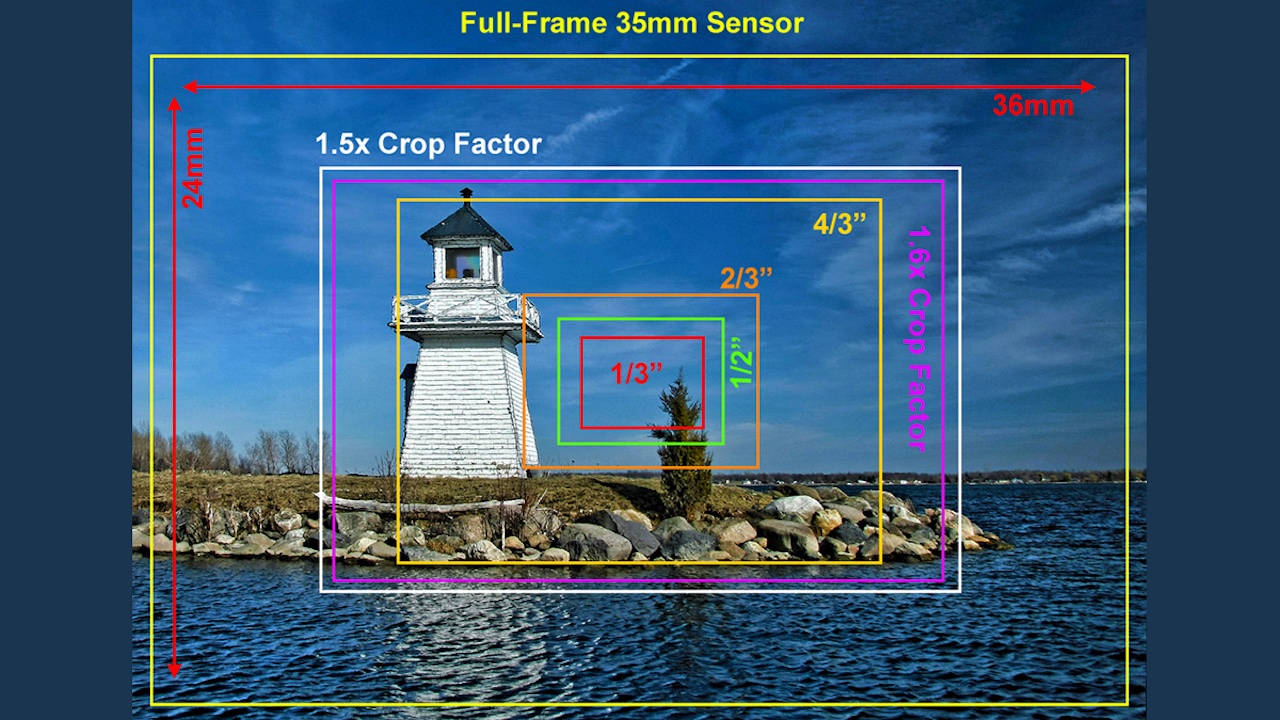
The first practical concept is crop factor. Because a Full Frame sensor is larger than a Super 35 sensor, the same focal length gives a wider angle of view. To reproduce the same angle of view on a larger format, we normally move to a longer focal length.
Photographers familiar with APS-C and Full Frame still cameras will recognize the principle immediately. In cinema, however, the comparison is less standardized. There is no single universal digital cinema sensor size, so the crop factor depends on the Super 35 reference we choose and on the particular camera format we are comparing it with. For practical purposes, I find 3-perf Super 35, with an approximate diagonal of 28.50mm, a useful reference.

An 18mm lens on a Full Frame camera and on a Super 35 camera. Source: www.improvephotography.com.
VERY IMPORTANT: focal length does not change with the format. A 50mm lens remains a 50mm lens whether it is used on Super 16, Super 35, Full Frame or 65mm. What changes is the angle of view that the lens produces on each negative or sensor size.
This is why the common question “what does this 50mm become on Full Frame?” is technically misleading. It does not become anything else. It remains a 50mm lens. It simply sees a different portion of the world because the sensor behind it is larger or smaller.
Let us take a practical example. Imagine that, from experience, we know that a 24mm lens would be appropriate for a given shot in 3-perf Super 35. To find the equivalent angle of view on a Sony VENICE, we compare the diagonals:
- Reference focal length in 3-perf Super 35: 24mm.
- Reference diagonal of 3-perf Super 35: 28.50mm.
- Reference diagonal of Sony VENICE: 43.50mm.
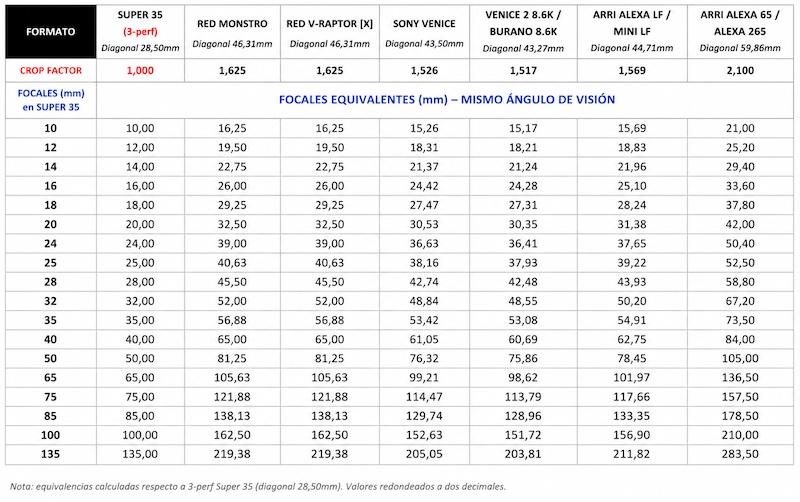
Focal length equivalence table between Super 35 and several Large Format camera systems. Source: own calculation.
The crop factor is obtained by dividing the larger format diagonal by the Super 35 reference diagonal:
43.50mm / 28.50mm = 1.52
Then we multiply the Super 35 focal length by that factor:
24mm × 1.52 = 36.63mm
So a 24mm lens on 3-perf Super 35 gives approximately the same angle of view as a 36.63mm lens on a Sony VENICE. In practical terms, we would probably choose a 35mm lens.

Source: www.improvephotography.com.
In most current Full Frame cinema cameras, the multiplication factor compared with 3-perf Super 35 is roughly around 1.5x or 1.6x. If we do not want to calculate every focal length on set, there is a simpler practical rule.
Take a classic Zeiss Super Speed T1.3 set: 18, 25, 35, 50 and 85mm. To obtain broadly similar angles of view in Full Frame, we usually “move up” one focal length. Instead of an 18mm, we use a 25mm. Instead of a 25mm, we use a 35mm. Instead of a 35mm, we use a 50mm, and so on.
This also changes the long end of the set. If an 85mm lens often acted as a portrait telephoto in Super 35, a Full Frame set may need a 135mm to perform a similar role. That is one of the reasons why 135mm, 180mm and 200mm lenses, which can sometimes feel too long in Super 35, become more useful in Large Format cinematography.
The same logic affects the wide end. In Full Frame, lens sets often begin around 24mm or 28mm, because those focal lengths already produce very wide fields of view. Shorter focal lengths still exist, of course, but their use becomes more specific and more visually assertive.
DEPTH OF FIELD
Once we understand how Full Frame changes focal-length choices, we can also understand why it tends to reduce depth of field. If we move from a 35mm to a 50mm, or from a 50mm to an 85mm, in order to keep a similar angle of view, we are using longer focal lengths for the same framing. That naturally reduces depth of field.
The full optical explanation involves focal length, aperture, subject distance, enlargement and circle of confusion. On set, however, the practical rule is easier to remember: wider lenses tend to give more depth of field, while longer lenses give less.

Theoretical explanation:
If a 24mm lens in 3-perf Super 35 gives a similar angle of view to a 36.63mm lens on a Sony VENICE, the depth of field will not automatically match. To equalize it, we also need to compensate the aperture. In cinematography we usually think in T-stops for exposure, although strictly speaking depth of field is governed by the physical aperture and f-number.
Using the same example, if the Super 35 shot was made at T2.8, the equivalent depth of field on a Sony VENICE would require approximately:
T2.8 × 1.52 = T4.25
In other words, to match both angle of view and depth of field exactly, we would need a 36.63mm lens and an aperture around T4.25. Since such exact focal lengths and apertures are rarely available or useful in practice, the working rule is simple: to obtain a depth of field similar to Super 35, Full Frame usually needs to be stopped down by roughly one stop and one third.

Practical explanation:
In real shooting conditions, however, aperture is not chosen only for depth of field. It is often determined by the light level, the available fixtures, the schedule, the location and the exposure strategy. Closing one stop and a third can mean using more than twice as much light. That may be possible on a stage. It may not be possible at dusk, on location, or in a situation based on available light.
For that reason, it is fair to say that Full Frame generally produces less depth of field than Super 35 when used in comparable working conditions. The difference is not as dramatic as the gap between Super 35 spherical and 35mm anamorphic photography, where the effective factor can be close to 2x. But it is significant enough to affect blocking, focus pulling, lighting levels and lens choice.
In some cases, one possible solution is to increase sensitivity rather than increase light. Depending on the camera, recording mode and final delivery, shooting at 1600 ISO instead of 800 ISO may be acceptable, especially if the project will finish in 2K or HD and the higher-resolution image will be downsampled. For high-end work, theatrical projection or 4K finishing, this requires more caution. Raising sensitivity may affect noise, highlight protection, shadow latitude or the position of middle gray, depending on the camera system and workflow.
PERSPECTIVE
Perspective is harder to quantify than crop factor, but it is often the most important artistic argument in favor of Full Frame and 65mm digital cinematography.
Because larger formats usually lead us toward longer focal lengths for the same angle of view, they can reduce the need for extremely wide lenses. In Super 35, a 12mm, 14mm, 16mm or 18mm lens may be needed for a wide shot. In Full Frame, a similar field of view may be obtained with a 20mm, 24mm or 28mm lens. Those lenses are often easier to control optically and may introduce less obvious spatial distortion.
This is one reason why Large Format images are sometimes described as more natural or more pictorial. The image can feel wide without relying so heavily on the (often) exaggerated geometry of very short focal lengths. That does not mean the format is automatically better. It means that the relationship between lens, distance and space changes. Some people claim that this makes the images feel more immersive.
There is also a clear historical connection with 35mm still photography and medium-format photography. Full Frame digital cinematography recalls the 24 × 36mm still frame. The larger 65mm systems move closer to the feeling of medium format. This association is not only technical. It affects how faces, spaces and backgrounds are perceived.

Paul Thomas Anderson shot The Master in 65mm partly because of its relationship with medium-format photography.
The current fashion for shallow depth of field has undoubtedly helped the adoption of Full Frame. Advertising, music videos and some narrative work have often embraced images that drift in and out of focus. But this also introduces real production issues. Focus pulling becomes harder. Lighting may become more expensive if the cinematographer wants to recover depth of field. And in some lens sets, the longer focal lengths required for equivalent framing may also bring less favorable minimum focus distances. All of this has to be tested before the shoot.
ADVANTAGES AND DISADVANTAGES OF LARGE FORMAT
Advantages — in no particular order:
- Large Format cameras use sensors substantially larger than Super 35 cameras. This can contribute to images with greater clarity, definition and long-term technical robustness. The obvious current exception is the ARRI Alexa 35, which remains Super 35 but represents a major generational step in sensor design.
- Larger formats allow cinematographers to use more moderate, “noble” focal lengths for wider views. This can produce a perspective that feels more natural, stable or pictorial than images built around very short focal lengths on smaller formats.
- Higher resolution and larger capture areas can offer more flexibility for small reframings, stabilization or postproduction adjustments, provided the workflow and delivery format allow it.
- In some circumstances, the larger sensor area and higher capture resolution may make higher ISO values more usable, especially when the final image is downsampled to 4K, 2K or HD.
- Large Format images tend to reveal their full value on large cinema screens or high-quality home-cinema displays, where scale, texture and optical separation become more visible.
Disadvantages — also in no particular order:
- Full Frame and Large Format camera packages are often more expensive to rent, and their files can be heavier to store, process and archive.
- The move toward longer focal lengths reduces depth of field, which can increase lighting requirements if the cinematographer wants to compensate by stopping down.
- Reduced depth of field makes focus pulling more demanding. Minimum focus distances may also become less favorable with certain lenses or focal lengths.
- The difference in look exists, but it is not always as immediately visible as the classic difference between Super 35 spherical and 35mm anamorphic photography. If the format is not used deliberately, or if the final image is viewed mainly on television or in 2K projection, it may be difficult to distinguish from a well-shot Super 35 image.
- Many classic lenses designed specifically for Super 35 do not fully cover Full Frame. Canon K35 lenses are one of the better-known exceptions, largely because of their origin in Canon FD still-photography glass. In recent years, the rehousing of Full Frame still-photography lenses — Canon FD, Leica R, Olympus Zuiko, Zeiss Contax and others — has become increasingly common, while manufacturers have also released new Full Frame cinema lenses with more vintage-inspired optical behavior.
For that reason, the best advice remains the old one: test, test, test. Full Frame is not a magic look. It is a set of physical conditions. Its value depends on whether those conditions serve the visual idea of the project.
Seen from that perspective, Full Frame, VistaVision and 65mm digital cinematography are not merely technical formats. They are ways of reorganizing the relationship between lenses, bodies, spaces and backgrounds. That is why recent films such as The Brutalist, One Battle After Another and Bugonia have helped bring the conversation back to large-format capture, not only as a matter of resolution, but as a way of thinking about scale, texture and theatrical presence.
* Super 35 did not become common until the early 1980s. The earlier 35mm Academy standard used a slightly smaller image area because part of the film width was reserved for the optical soundtrack. Some lenses designed before the Super 35 era may therefore show coverage problems on wider Super 35 or digital sensor areas, especially in the shorter focal lengths.
** This is especially true in wide-angle lenses. Longer focal lengths often project larger image circles and may cover more than the format for which they were originally designed.
Back to: Full-Frame Cinema — Part I: Large Format and VistaVision
Continues in Spanish with: Full Frame Cinema Lenses
More English-language cinematography essays are available here: ON FILM & DIGITAL in English.
Related articles and sources
- Full-Frame Cinema: A Practical Guide to Large Format and VistaVision (Part I)
- Spanish version: Formato Full Frame en cine — Parte I
- Spanish version: Formato Full Frame en cine — Parte II
- Film Formats Guide: 35mm, CinemaScope, VistaVision, 70mm and IMAX
- The Anamorphic Format in Cinema: a Practical Guide to Anamorphic Lenses
- The Motion Picture Negative (II): Format, Film Speed, Film Stocks and Grain
- Phil Holland Format Comparator
- RED MONSTRO 8K VV — technical specifications
- RED V-RAPTOR 8K VV — technical specifications
- Sony VENICE — technical specifications
- Sony VENICE 2 — technical specifications
- Sony BURANO — technical specifications
- ARRI Alexa Mini LF — technical specifications
- ARRI Alexa 65 — technical specifications
- ARRI Alexa 265 — technical specifications
- Blackmagic URSA Cine — technical specifications
ON FILM & DIGITAL
© Original Spanish article, Ignacio Aguilar, 2019. Revised by the author in 2026. English version revised and adapted for an international readership.
This article is part of ON FILM & DIGITAL in English, Ignacio Aguilar AEC’s archive of cinematography essays, technical guides, lens tests and film photography reviews.
The Author
Ignacio Aguilar, AEC is a cinematographer / director of photography based in Madrid, Spain. His work spans feature films, television, commercials and technical writing on cinematography, with experience in digital cinema, 16mm and 35mm film, anamorphic lenses, large-format digital capture, lens testing and film-based workflows.
He is a member of the Spanish Society of Cinematographers (AEC) and the Spanish Academy of Cinema, a Sony I.C.E. Certified Expert and a Cooke SP3 ambassador. His writing has appeared in American Cinematographer and Camera & Light, and ON FILM & DIGITAL gathers his bilingual essays, technical guides and cinematography reviews.
For professional work, collaborations, lectures, workshops or cinematography consulting, visit his professional biography, selected works or contact page.