

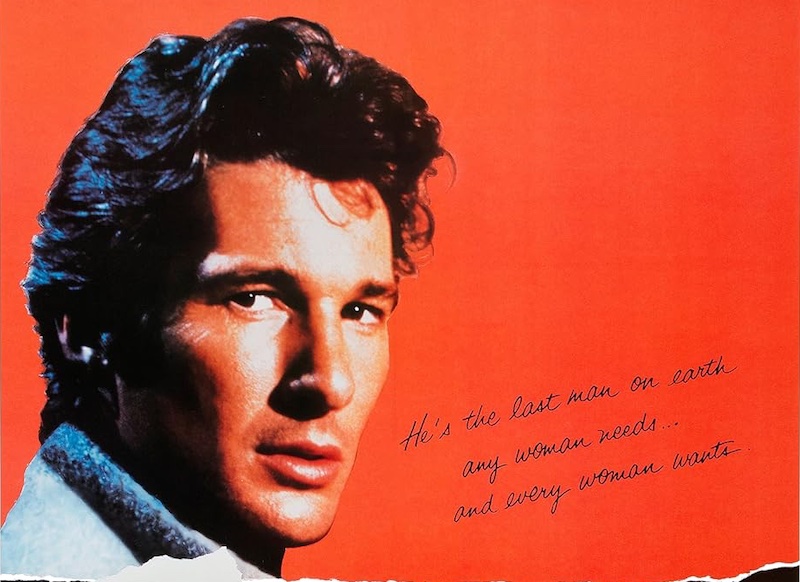
“Breathless”
Spanish Title: Vivir sin Aliento
Year of Production: 1983
Director: Jim McBride
Director of Photography: Richard H. Kline, ASC
Lenses: Panavision Ultra Speed Mk II
Film Stock: Kodak 5293, 250T
Format and Aspect Ratio: 35mm spherical, 1.85:1
Stolen cars, red skies, rock-and-roll mythology and a camera caught between artificiality and dream: Jim McBride and Richard H. Kline turn Breathless into an uneven but strangely fascinating pop neo-noir.
The Film
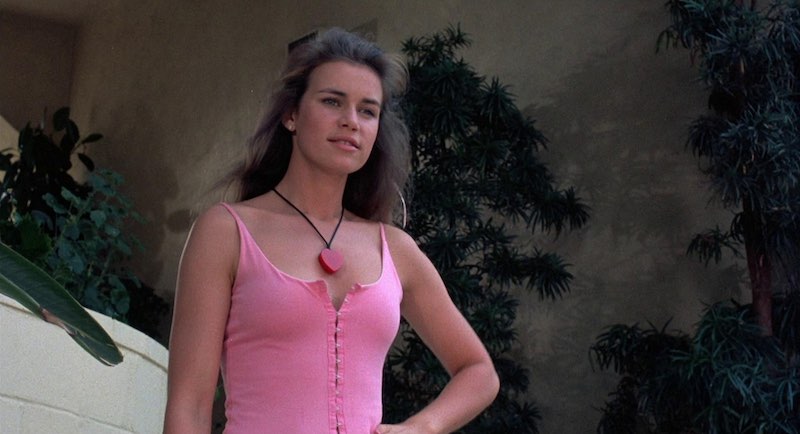
Breathless is the American remake of Jean-Luc Godard’s À bout de souffle (1960), here reversing the nationalities of the two main characters. The Jean-Paul Belmondo role — a French petty criminal who draws an American woman into his world — becomes Jesse Lujack, played by Richard Gere. The Jean Seberg role becomes Monica Poiccard, played by the French actress Valérie Kaprisky.
The film was attacked very harshly when it was released, and it is not difficult to understand why. It lacks the artistic shock, formal freshness and cultural importance of Godard’s original. It also has characters who are more stylized than emotionally involving. Yet the film can still be watched with some interest, especially if it is approached less as a conventional narrative and more as a fantasy inside Jesse’s head.
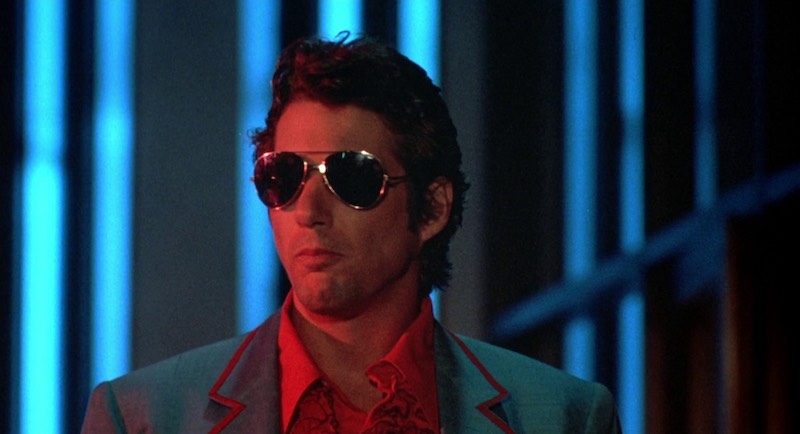
Jesse dreams in comics, stolen cars, Jerry Lee Lewis, neon color and movie gestures. He behaves as if he were living in a parallel version of Los Angeles, one made from pop culture and adolescent self-invention. That does not make the film fully successful, but it gives it a more coherent key than a direct comparison with Godard. Jack Nitzsche’s music and the film’s song choices are also central to that unstable, heightened atmosphere.
The Cinematographer
The cinematographer was Richard H. Kline, ASC, one of the most interesting Hollywood cinematographers from the late 1960s through the early 1980s. His first credits as cinematographer were in television, but he quickly moved into features and received an Academy Award nomination for Camelot (Joshua Logan, 1967). Around the same time, he began a productive collaboration with Richard Fleischer, starting with The Boston Strangler (1968).
That association continued with Soylent Green (1973), The Don Is Dead (1973), Mr. Majestyk (1974) and Mandingo (1975). With Robert Wise, Kline photographed The Andromeda Strain (1971) and Star Trek: The Motion Picture (1979), two major examples of large-scale studio filmmaking and also essential references for the use of split diopters. He received his second Oscar nomination for John Guillermin’s King Kong (1976).
Kline also photographed thrillers such as The Mechanic (Michael Winner, 1972) and The Fury (Brian De Palma, 1978), as well as films by directors such as Karel Reisz, with Who’ll Stop the Rain (1978), and William Friedkin, with Deal of the Century (1983). He also shot Lawrence Kasdan’s directorial debut, the celebrated Body Heat (1981). Later commercial disappointments, including Breathless and Howard the Duck (Willard Huyck, 1986), coincided with a decline in the level of projects available to him before his eventual retirement in the 1990s.
Visual Style Analysis
The cinematography of Breathless is somewhat fragmented, much like the film itself. It never fully decides whether it wants to be a conventional neo-noir story, a pop fantasy, a road movie, a remake, or a dream projected by its own protagonist. Kline’s work moves inside that same uncertainty. He was always an extremely capable cinematographer, technically strong and more than able to light major studio films with clarity and authority. But this material places him in less stable territory.
The comparison with Body Heat is useful. Kasdan’s film was a classical noir variation with very clear dramatic and photographic coordinates. Its heat, darkness, sensuality and controlled color belonged to a coherent design. Breathless is less settled. It wants the freedom of Godard, the energy of rock-and-roll, the artificiality of comic books and the surface of an early-1980s Los Angeles neo-noir. Those impulses do not always belong to the same film.
The opening car material, and several later scenes with Gere driving alone or with Kaprisky, move toward a more oneiric register. The reds and oranges suggest sunsets that are less naturalistic than emotional. They feel like a projection of Jesse’s fantasy life. But other dialogue scenes use process photography so openly that the effect becomes hard to read. It may be intended as a stylized quotation, the kind of artificial car work Quentin Tarantino would later embrace very consciously in Pulp Fiction (1994). It may also simply be an awkward result. The ambiguity is not especially productive.
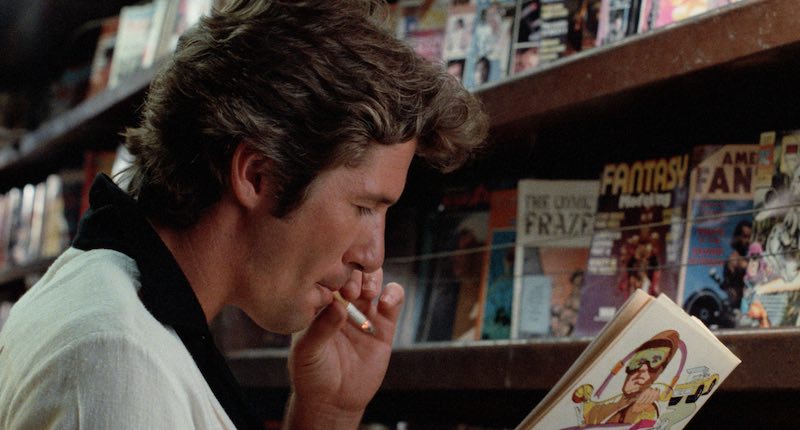
Outside those isolated passages, the film is more conventional than its reputation or concept might suggest. Some of the night exteriors, especially the chase near the end of the film, have strong and interesting backlight in the Los Angeles streets. The movie-theater sequence is another moment where the film seems to accept its own dream logic. But much of the remaining material is photographed in a relatively straightforward way, without a particularly strong attempt to idealize either Gere or Kaprisky.
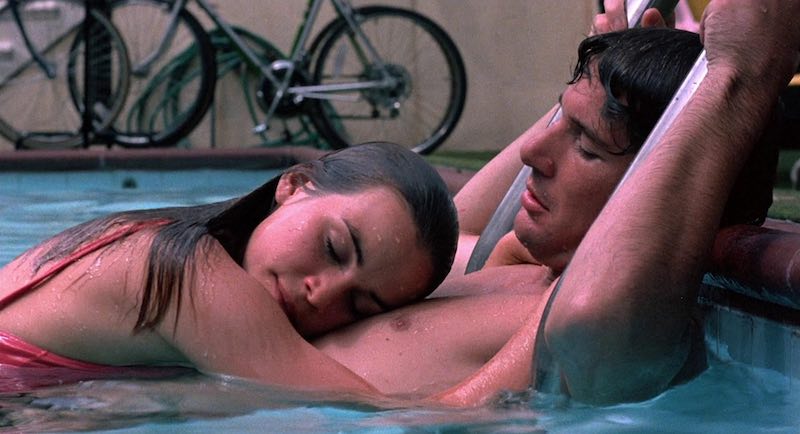
In that sense, Breathless often looks closer to late-1970s or early-1980s realism than to the more self-consciously stylized commercial cinema that was already emerging by 1983. Kline is clearly open to newer technical and visual possibilities, but he does not abandon his classical formation. When he lights and fills faces, the mechanism is often visible. One can feel the placement of the units, the intention to hold the actors, the fill level and the studio craft behind the image.
This is not necessarily a defect in itself. Kline’s work had always carried a strong professional finish. The problem is that Breathless often asks for either greater rawness or greater stylization. Instead, the photography sometimes falls between the two. It is too controlled to feel dangerous, but not controlled enough to become a fully designed pop hallucination.
At the same time, the film does show an awareness of the technical changes of its period. It appears to have been shot almost entirely with very fast lenses, using wide apertures when needed, and the grain structure suggests the use of Kodak 5293, the then-new 250T stock. Compared with the older Kodak 5247 100T, 5293 allowed cinematographers to work at lower light levels. That should have made Breathless a more flexible, available-light, location-driven film. Instead, the image often remains tied to Kline’s more classical instinct for shaping and supporting the actors.
Conclusion
Breathless is therefore a curious object in Richard H. Kline’s career. It shows his craft, but it also exposes its limits. In similar urban environments, Owen Roizman could make naturalism almost invisible, as he did in Straight Time (1978). Kline, by contrast, often lets the construction show. His lighting remains competent, sometimes attractive, but rarely disappears into behavior, weather, streetlight or location.
The comparison with Raoul Coutard’s work on Godard’s original is even more severe. There is nothing here with the same sense of rupture, speed or formal invention. That may be an unfair standard, because McBride’s film is not really trying to reproduce the historical function of À bout de souffle. But the comparison still clarifies the problem. This Breathless has the surface of rebellion without the photographic revolution that made the original so decisive.
The result leaves Kline’s version somewhere in between. It is not without fascination: the red skies, night streets, pop references and occasional dream images give the film a distinctive flavor. But the overall look often becomes theatrical rather than truly liberated. For a cinematographer who had previously moved beyond the artificial studio style in which he had been trained, Breathless feels like a partial retreat. Not a careless work, but an unresolved one.
Viewed on Blu-ray
ON FILM & DIGITAL
© Ignacio Aguilar, 2026.
This article is part of ON FILM & DIGITAL’s English-language cinematography reviews and essays.
These texts are not plot summaries or general film reviews, but cinematography-focused essays written from the perspective of a working cinematographer.
The Author
Ignacio Aguilar, AEC is a cinematographer / director of photography based in Madrid, Spain. His work spans feature films, television, commercials and technical writing on cinematography, with experience in digital cinema, 16mm and 35mm film, anamorphic lenses, large-format digital capture, lens testing and film-based workflows.
He is a member of the Spanish Society of Cinematographers (AEC) and the Spanish Academy of Cinema, a Sony I.C.E. Certified Expert and a Cooke SP3 ambassador. His writing has appeared in American Cinematographer and Camera & Light, and ON FILM & DIGITAL gathers his bilingual essays, technical guides and cinematography reviews.
For professional work, collaborations, lectures, workshops or cinematography consulting, visit his professional biography, selected works or contact page.
The Spanish-language archive is available at ON FILM & DIGITAL.