

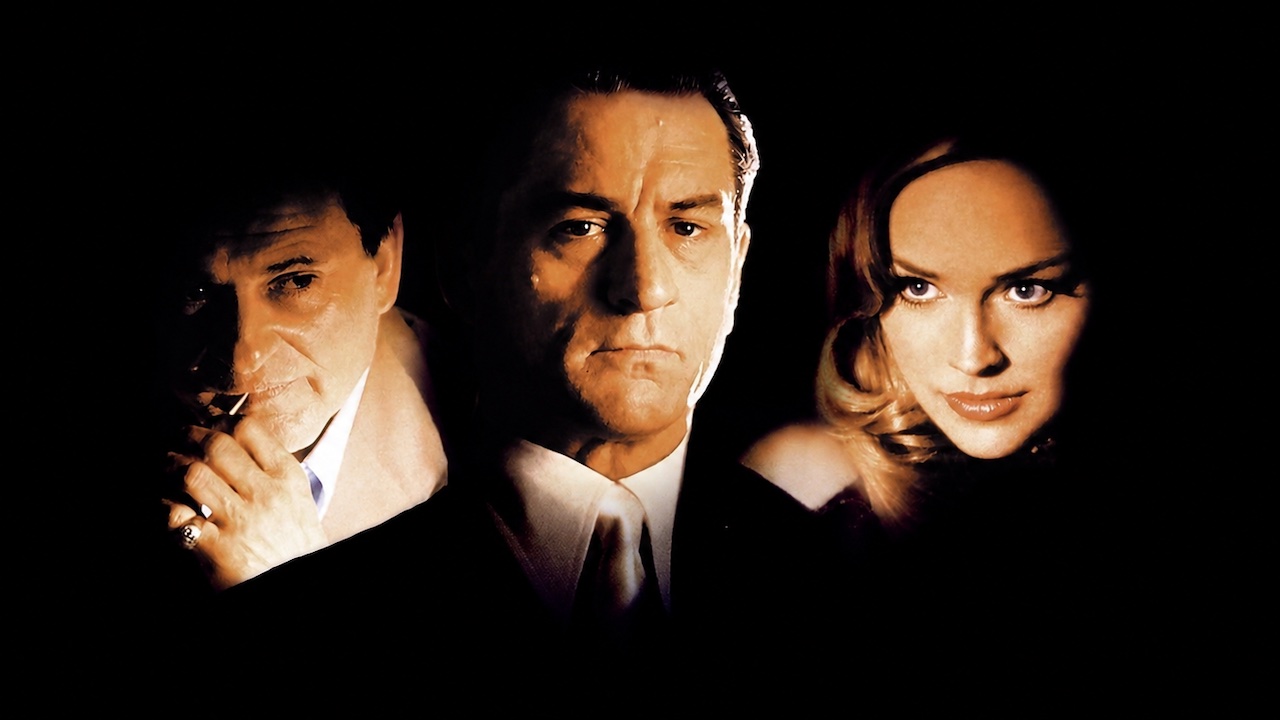
“Casino”
Spanish Title: Casino
Year of Production: 1995
Director: Martin Scorsese
Director of Photography: Robert Richardson, ASC
Lenses: Panavision Primo, Primo Zoom
Film Stock: Kodak EXR 5248 (100T), Kodak EXR 5293 (200T)
Format and Aspect Ratio: Super 35, 2.4:1
Viewed on: 35mm and 4K UHD HDR Blu-ray
Overhead light, Pro Mist diffusion, saturated color and Super 35 give Casino one of the most immediately identifiable looks in Martin Scorsese’s filmography.
The Film
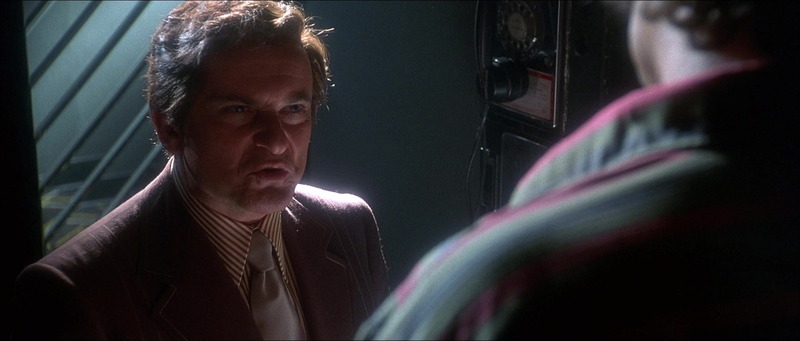
Martin Scorsese returned to gangster cinema with Casino, this time moving the mythology from New York streets into the controlled, artificial world of Las Vegas casinos in the late 1970s and early 1980s. Robert De Niro plays Sam Rothstein, the professional gambler installed by the East Coast mob to run one of the city’s major casinos. Sharon Stone plays Ginger, his wife, a former hustler whose volatility gradually becomes central to the film. Joe Pesci plays Nicky Santoro, a violent mobster and Rothstein’s longtime friend, who arrives in Las Vegas and quickly begins to treat the city as his own territory.
At the time of its release, the film was often seen as too close to Scorsese’s own Goodfellas (1990), both structurally and thematically. That comparison is understandable, but it is also limiting. Casino works less as a conventional piece of plot construction than as a wide, almost sociological fresco of a place, a period and a system of power. The story is carried by the voiceovers of De Niro and Pesci, but the real subject is the machinery around them: money, surveillance, desire, corruption and self-destruction. James Woods, Kevin Pollak, Alan King, Frank Vincent and Don Rickles complete the supporting cast.
The Cinematographer
Casino was Martin Scorsese’s first feature with Robert Richardson, ASC. Richardson had already met Scorsese during the preparation of Cape Fear (1991), although that film was ultimately photographed by Freddie Francis, BSC. By 1995, Richardson was one of the most visible American cinematographers of his generation, largely because of his work with Oliver Stone on films such as Salvador (1986), Platoon (1986), Wall Street (1987), Born on the Fourth of July (1989) and JFK (1991), for which he won his first Academy Award.
He later returned to Scorsese for Bringing Out the Dead (1999), The Aviator (2004) and Hugo (2011), winning his second and third Oscars for the latter two. Richardson also became one of Quentin Tarantino’s defining cinematographers, shooting Kill Bill (2003), Inglourious Basterds (2009), Django Unchained (2012), The Hateful Eight (2015) and Once Upon a Time in Hollywood (2019). His work on Scott Hicks’s Snow Falling on Cedars (1999) and Robert De Niro’s The Good Shepherd (2006) also shows the range of a cinematographer who has become one of the key American figures of the last four decades.
Visual Style Analysis
Technically, Casino was an unusual project for Richardson. When shooting widescreen films, he has generally favored 35mm anamorphic over Super 35. Here, partly under Scorsese’s influence after The Age of Innocence (1993), he worked in Super 35. In the mid-1990s, before digital intermediates became standard, that meant an optical blow-up for release prints, with the inevitable loss of image quality that came with the process.
Richardson’s response was to protect the negative as much as possible. He avoided 500T stocks and relied mainly on Kodak EXR 5248, rated at 100T, and Kodak EXR 5293, rated at 200T. The result is a very rich, saturated and photochemical image, but one with comparatively little grain. In 35mm, and especially now in 4K when the original negative is available, Casino has considerable density and color separation. The weaker moments tend to be optical transitions and effects shots, where the image cannot always return to the original camera negative and must come from a duplicate or intermediate element.
Richardson used Panavision Primo primes, but the film is strongly associated with the Primo zooms. He estimated that roughly three quarters of the picture was shot with the Primo 17.5-75mm T2.3. The zoom is not used only for visible zoom moves. Very often, it functions as a variable focal-length tool, allowing Scorsese and Richardson to adjust the frame with great precision while preserving the momentum of the scene.
The richness of the image does not come only from the photography. Dante Ferretti’s production design, the real casino locations and the costume design give Richardson an enormous amount of color, texture and reflective material to work with. To shape that material, he also used Tiffen Pro Mist filters, which were central to his style during this period. The filters soften contrast, bloom highlights and create strong halos around overexposed practicals and hard sources, a key part of the film’s surface.
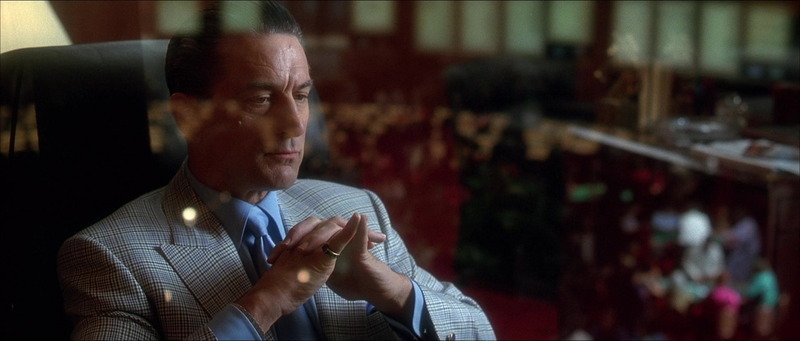
That surface is built around one of Richardson’s most recognizable methods: intense, often overhead sources placed in very specific positions. In some scenes, high-output units — sometimes Par Cans with VNSP bulbs — are aimed down toward tables or other surfaces. The sources themselves can run several stops overexposed, almost burning into the image, while their bounce brings the actors’ faces into the proper range. It is a bold way of lighting because it produces high contrast, but the Pro Mist diffusion prevents the image from becoming too brittle.
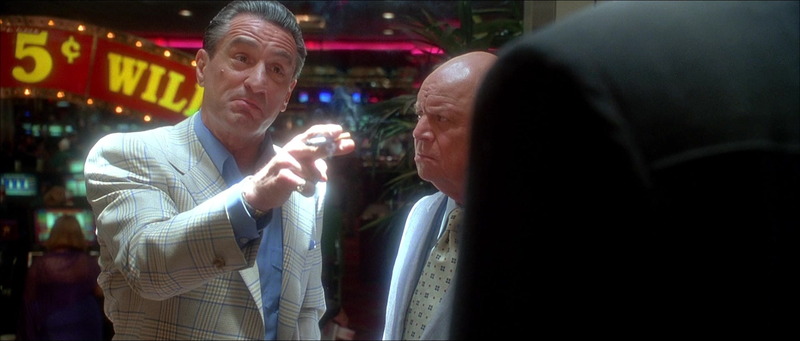
Richardson also pushes those hard sources through windows, or uses them as visible beams of light. In some night exteriors, the whole scene seems to be organized around a single, extremely intense overhead source. This is one of the visual signatures of Casino. The lighting can feel excessive, and it is meant to. Scorsese is describing a world of money, noise, surveillance and spectacle. Richardson’s overexposure gives that world a visual logic rather than simply decorating it.
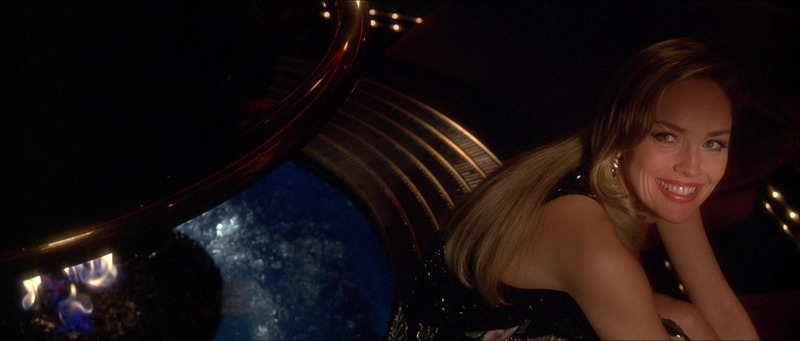
At the same time, the film is carefully designed around the actors. Richardson treats De Niro and Stone especially well. The lighting is soft when it needs to be, flattering without becoming bland, and the Pro Mist gives Stone’s early scenes a glamour that is clearly part of Ginger’s function within the story. There are also individual images that have become central to the film’s memory, including the desert meeting between De Niro and Pesci, with its saturated blue sky, diffusion and the famous reflection in the sunglasses.
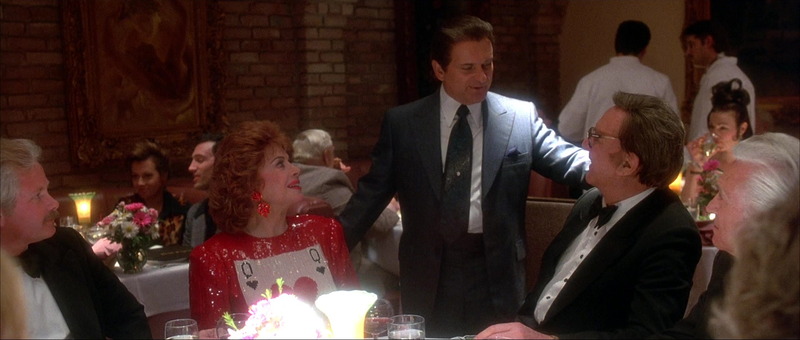
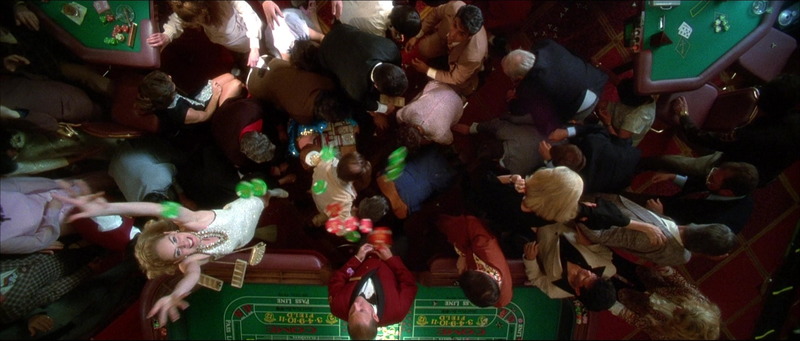
The camerawork belongs unmistakably to Scorsese. The lenses often lean toward wider focal lengths, and the camera rarely seems completely still. There are Steadicam shots, dollies, push-ins, zooms, combinations of zoom and camera movement, slow motion and overhead angles. The camera keeps the film in a constant state of circulation, as if it were following the same movement as money through the casino.
One of the best-known examples is the overhead shot of Sharon Stone throwing casino chips into the air. It is a perfect Scorsese-Richardson image: theatrical, controlled, excessive and completely direct. It does not merely illustrate Ginger’s entrance into the world of the film. It turns that entrance into an emblem of the film’s entire visual system.
Conclusion
Casino may not be Robert Richardson’s finest cinematography, nor Martin Scorsese’s greatest film. But ranking it that way misses part of its value. The film is extremely revealing for both artists. Their obsessions are on the surface: light as pressure, movement as structure, mise-en-scène as energy, and excess as a dramatic method.
As a period film set in a relatively recent past, it has aged unusually well. Its visual choices are not neutral, but they are coherent. The saturation, the diffusion, the overhead sources, the zooms and the production design all belong to the same system. From a cinematographer’s point of view, the difference between Michael Ballhaus’s elegant classicism and Richardson’s more aggressive, American, high-voltage approach is enormous. In Casino, Scorsese did not simply change cinematographers. He changed the temperature of his images.
ON FILM & DIGITAL
© Ignacio Aguilar, 2026.
This article is part of ON FILM & DIGITAL’s English-language cinematography reviews and essays.
These texts are not plot summaries or general film reviews, but cinematography-focused essays written from the perspective of a working cinematographer.
The Author
Ignacio Aguilar is available for cinematography work, creative collaborations, lectures, workshops and international projects. He is a Sony Independent Certified Expert (ICE) and Cooke Optics Spanish Ambassador for Cooke SP3 lenses. Contact here.