

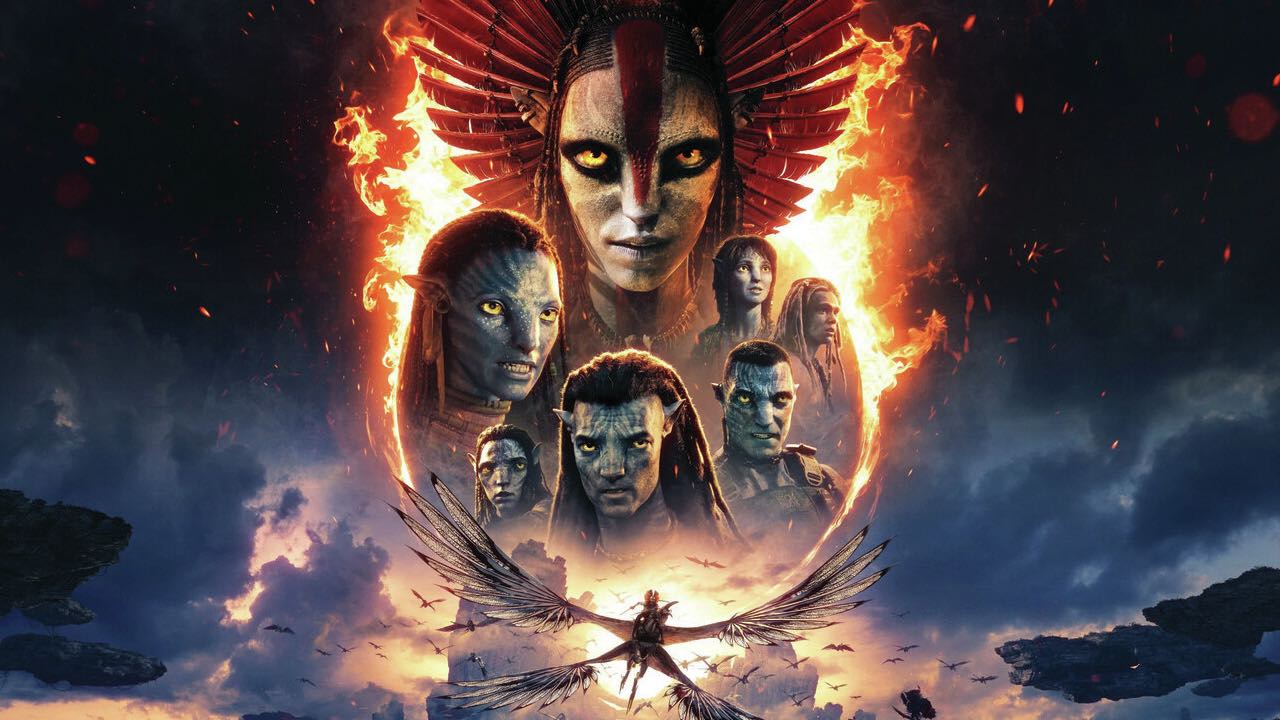
“Avatar: Fire and Ash”
Spanish Title: Avatar, Fuego y Ceniza
Year of Production: 2025
Director: James Cameron
Director of Photography: Russell Carpenter, ASC
Lenses: Fujinon MK & Cabrio
Format and Aspect Ratio: Sony CineAlta VENICE, X-OCN 4K, Dual Strip 3D, 1.85:1 in 3D or 2.39:1 in 2D
Viewed on: IMAX 3D HFR (2K)
3D HFR, Sony VENICE and Russell Carpenter in the service of a technically overwhelming Pandora, though one that feels increasingly less surprising.
The Film
The second sequel to “Avatar” (2009), and a direct continuation of the excellent “Avatar: The Way of Water” (2022), “Avatar: Fire and Ash” allows James Cameron to push further into the world of Pandora. This time, the story takes place shortly after the events of the previous film. The resurrected Colonel Miles Quaritch, played by Stephen Lang, is still determined to recover his son Spider, played by Jack Champion, and capture Jake Sully, played by Sam Worthington. To do so, he allies himself with the leader of a dangerous native tribe, played by Oona Chaplin, while within the Sully family, their adopted daughter Kiri, played by Sigourney Weaver, begins to develop strange powers.
“Avatar: Fire and Ash” does not merely feel like more of the same. In many ways, it is more of the same. Cameron has never relied primarily on narrative novelty — beyond the original “Terminator”, much of his filmography has been built around sequels, variations, or large-scale reworkings of familiar genre material — but here the lack of new dramatic ideas, or at least the limited development of the ideas that are present, is more noticeable than usual. Even so, the film remains a first-rate spectacle when seen in its native format, 3D HFR. Every dollar spent on the production is clearly visible on screen, particularly in the visual effects and in the extraordinary motion-capture work that turns live actors into animated characters with astonishing precision. Zoe Saldaña, Kate Winslet, David Thewlis and Giovanni Ribisi complete the cast.
The Cinematographer
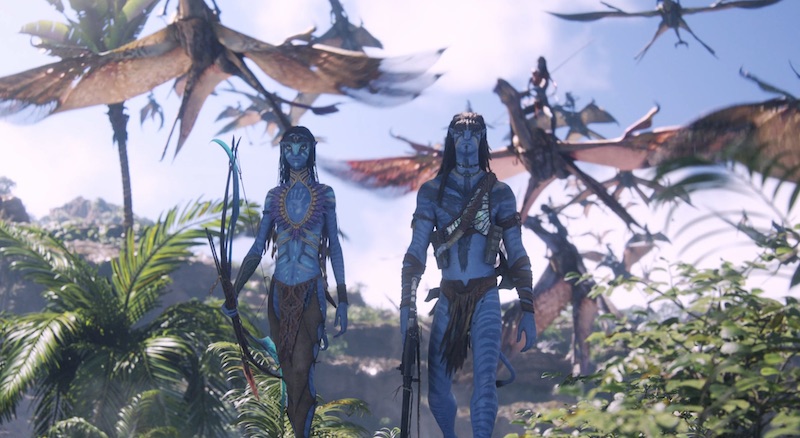
The cinematographer is once again Russell Carpenter, ASC, who shot the principal photography for both films with James Cameron, one after the other. Carpenter is best known, of course, for his association with the Canadian director. Together they made “True Lies” (1994), the 65mm short “Terminator 2 3-D: Battle Across Time” (1996) for Universal Studios, and, most famously, “Titanic” (1997). It should be remembered, however, that Cameron’s original choice for “Titanic” was Caleb Deschanel, who actually began shooting the modern-day sequences in Halifax. Carpenter ultimately photographed the bulk of the film and won both the Academy Award and the American Society of Cinematographers Award for his work.
Curiously, when Cameron returned to directing with “Avatar” in 2009, he did not bring Carpenter back. Instead, he worked with Mauro Fiore, who won one of the more debated cinematography Oscars in the history of the Academy Awards, given that only a portion of the finished film contained conventional live-action footage. Beyond his collaborations with Cameron, the veteran Carpenter’s filmography includes action and studio titles such as “Solar Crisis” (Richard C. Sarafian, 1990), “Hard Target” (John Woo, 1993), “The Negotiator” (F. Gary Gray, 1998), “Charlie’s Angels” (McG, 2000), “Monster-in-Law” (Robert Luketic, 2005), “This Means War” (McG, 2012) and “Ant-Man” (Peyton Reed, 2015).
Visual Style Analysis
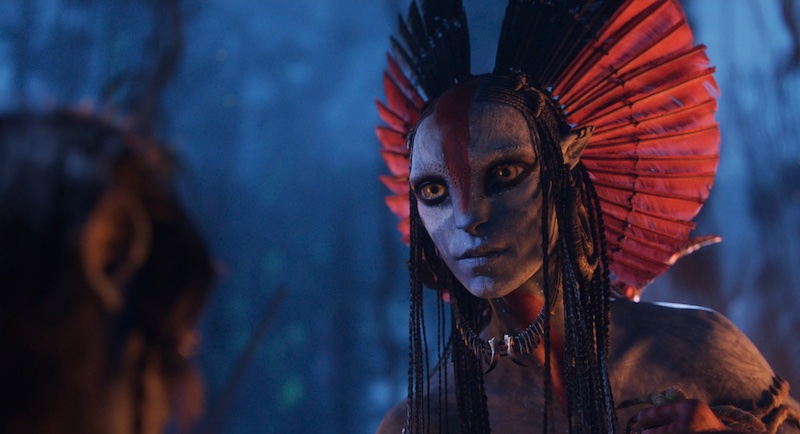
Visually, “Avatar: Fire and Ash” belongs to the same production and aesthetic system as “Avatar: The Way of Water”: a hybrid form of cinema in which performance capture, stereoscopic staging, digital environments and live-action fragments are integrated into a single large-scale image-making process.
Technically, because the two films were shot simultaneously, the specifications of “Avatar: Fire and Ash” are the same as those of “Avatar: The Way of Water”. Both were photographed with the Sony VENICE in 4K, using Fujinon MK and Cabrio zoom lenses, on 3D rigs built around the Rialto extension system. That configuration allowed the stereoscopic rigs to be far more compact and manageable than they would have been with the full camera body of a Sony VENICE, or an ARRI Alexa, mounted in a more conventional setup.
Even “The Way of Water” contained relatively little footage that could be described as straightforward live action: actors photographed in physical environments, without being transformed into Na’vi or surrounded by extensive post-production work. In “Fire and Ash”, that kind of material feels even less significant within a running time of almost 200 minutes.
For that reason, as with the previous film, “Fire and Ash” cannot really be judged in the strict terms usually applied to cinematography. There are few fully built physical sets. What tends to appear instead are small constructed areas, partial environments, or fragments of real space that are then extended into vast digital worlds. Judging by the finished film, the shoot seems to have provided the necessary physical and performance material for an enormous post-production process. In this case, post-production does not simply finish the film, as it usually would. It effectively creates it.
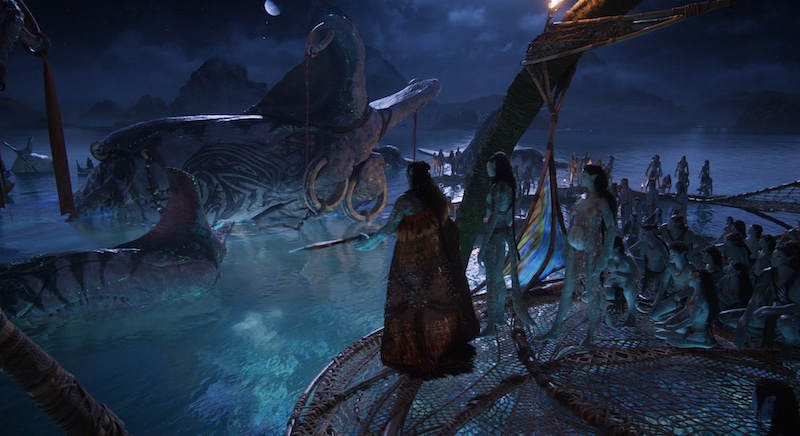
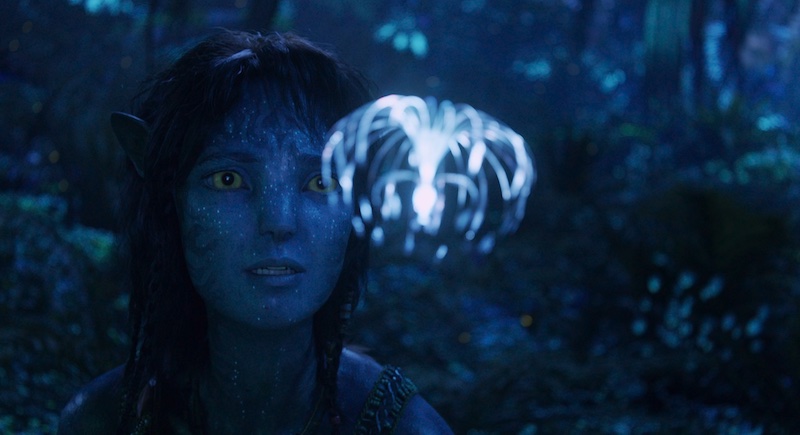
Within that context, what can be seen of Russell Carpenter’s work is very strong. The money is on screen, certainly, but the impact is not only a matter of digital execution. It also comes from the way Cameron — and, presumably, his cinematographer — organize the image for stereoscopic space. Camera position, height, blocking, foreground placement, background activity, planes of action, the degree of defocus, and the arrangement of visual elements in front of and behind the characters are all carefully designed to create depth. That depth is not decorative. It is the basis of the image. In “Avatar: Fire and Ash”, the 3D image often feels unusually pure and unusually spatial.
It is also important to note the film’s use of frame rate. In general, dialogue scenes are presented at the standard 24 frames per second, while most of the underwater material and the action sequences are shown at 48 frames per second. When the film is seen as designed, in HFR — High Frame Rate — the 24 fps scenes retain a more traditional cadence, while the 48 fps passages acquire a smoother, more immediate quality. In this specific 3D context, the effect is often natural and functional. In a live-action 2D feature, at least for this viewer, the same effect would likely be far harder to tolerate.
The result, as in “The Way of Water”, is a remarkably complete sense of immersion. The motion capture is so refined that one sometimes questions whether a given close-up is entirely digital, heavily augmented live action, or even an actor in elaborate makeup. During the action sequences, the amount of visual information on screen is often astonishing: characters, objects, environments, particles and movement all coexist within the same frame without collapsing into visual chaos. That level of control is one of the clearest signs of the production’s technical sophistication.
Conclusion
From a technical point of view, the results are overwhelming. As in the previous film, Pandora and its inhabitants are recreated with extraordinary consistency. The film also benefits from having filmmakers in control who understand staging and know how to explore the dramatic possibilities of 3D and HFR. Even when some of Cameron’s technical decisions regarding the presentation of his films may be open to debate, there is no doubt that he cares deeply about the visual quality of his work.
The problem is that “Avatar: The Way of Water” had a conceptual beauty that gave its technology a clear emotional purpose. It described an idyllic world in which its characters lived, moved, played and belonged. The technique served the environment, and the environment served a set of simple but effective emotional ideas. The story in “The Way of Water” was also very simple, but the film’s visual and sensory design gave that simplicity a certain grace.
In “Fire and Ash”, the screenplay matters less than the spectacle, as is often the case in this series. But this time the dramatic material feels so thinly developed that it begins to affect the whole. Scenes, situations and action beats are repeated in ways that make them feel almost interchangeable. The craft remains formidable, but the sense of discovery is diminished.
That is where the film suffers most. The beauty of “The Way of Water” generated surprise. It had an undeniable spark and remains, thanks to its 3D HFR presentation, one of the great theatrical spectacles I have ever seen. “Fire and Ash” can still be jaw-dropping, but it no longer surprises in the same way. Nor is it as audiovisually beautiful as the previous film, which for me surpassed the original “Avatar” in virtually every respect.
In that sense, it is a pity that a filmmaker with Cameron’s gifts has not applied this extraordinary technical machinery to a new project, a different world, or a fresh set of visual ideas. Pandora remains enjoyable, but it is beginning to show clear signs of fatigue. One can only hope that, at almost 72 years old, the creator of “Aliens” — a film very openly echoed here — still has the energy to do exactly that.
ON FILM & DIGITAL
© Ignacio Aguilar, 2026.
This article is part of ON FILM & DIGITAL’s English-language cinematography reviews and essays.
These texts are not plot summaries or general film reviews, but cinematography-focused essays written from the perspective of a working cinematographer.
The Author
Ignacio Aguilar is available for cinematography work, creative collaborations, lectures, workshops and international projects. He is a Sony Independent Certified Expert (ICE) and Cooke Optics Spanish Ambassador for Cooke SP3 lenses. Contact here.