

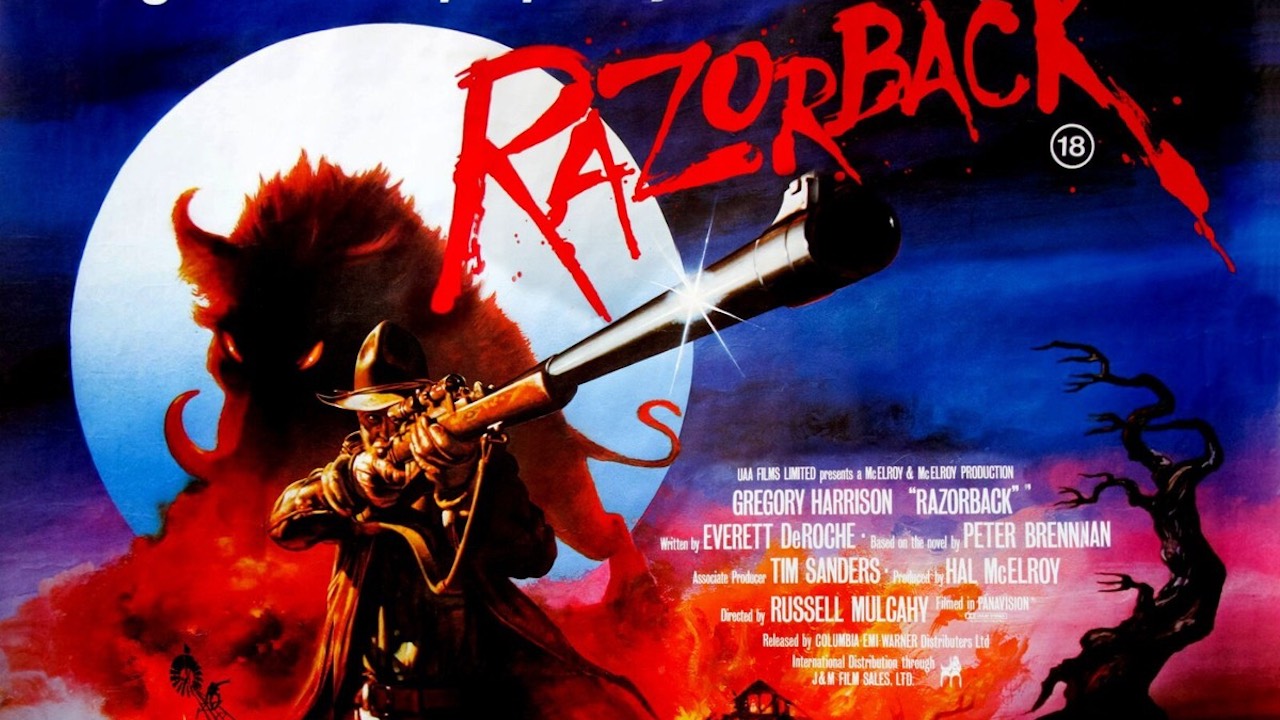
“Razorback”
Spanish Title: Razorback, los colmillos del infierno
Year of Production: 1984
Director: Russell Mulcahy
Director of Photography: Dean Semler, ASC, ACS
Lenses: Panavision C-Series, Panavision E-Series
Format and Aspect Ratio: 35mm anamorphic (Panavision), 2.4:1
Viewed on: 4K UHD Blu-ray
A visually extreme Australian horror film in which Dean Semler, ASC, ACS turns the outback into a stylized arena of polarized skies, smoke, hard backlight and anamorphic excess.
The Film
Russell Mulcahy’s feature directing debut adapts Peter Brennan’s novel, set in the Australian outback. In a remote settlement populated by eccentric and often unpleasant characters, a giant wild boar terrorizes the area. The husband of one of its victims (Gregory Harrison) joins forces with a local hunter (Bill Kerr), a man who lost his family in one of the animal’s attacks, in an attempt to destroy the monster.
“Razorback” has a certain reputation within fantasy and horror cinema, and that reputation makes some sense if one considers its audiovisual surface in isolation. As a film, however, it is far less convincing. It has the absolute temperament of a music video — not only in its imagery, but also in its syncopated editing — with little or no character development and a monster whose appearances and attacks are, at best, only partially successful. Even so, the film drew enough attention for Mulcahy to continue his career in cinema. “Highlander” would follow in 1986, and, despite its own flaws, is a much stronger film. “Razorback” has nevertheless become a strange cult object.
The Cinematographer
The cinematographer was Australian director of photography Dean Semler, ASC, ACS, still in the early stages of his career, although he had already attracted international attention for his excellent work on “The Road Warrior” (George Miller, 1981), the first sequel to “Mad Max” (1979). He would also photograph “Mad Max: Beyond Thunderdome” (1985) and the well-known “Dead Calm” (Philip Noyce, 1989) before beginning his Hollywood career.
Soon afterward, Semler achieved major success with “Dances With Wolves” (Kevin Costner, 1990), winning the Academy Award for Best Cinematography. Rather than pursuing mainly prestige projects afterward, he built much of his later career around commercial films, either comedies or highly technical action pictures: “Last Action Hero” (John McTiernan, 1993), “Waterworld” (Kevin Reynolds, 1995), “We Were Soldiers” (Randall Wallace, 2002), and “Apocalypto” (Mel Gibson, 2006) are examples of the latter. He also returned to the Western with “The Alamo” (John Lee Hancock, 2004) and the very estimable “Appaloosa” (Ed Harris, 2008).
Visual Style Analysis
The image of “Razorback” is curious because it uses locations — or places that feel very close to them — reminiscent of “Walkabout” (Nicolas Roeg, 1971) and especially “The Road Warrior.” But in George Miller’s film, Semler had photographed large desert exteriors in a style that still felt fundamentally classical, with particularly strong work in low-light night situations. “Razorback” is something else. It is pure aestheticism, comparable in attitude to “The Hunger” (Tony Scott, 1983) or, even more, “The Keep” (Michael Mann, 1983), except that this logic is applied mainly to large day and night exteriors rather than to interiors.
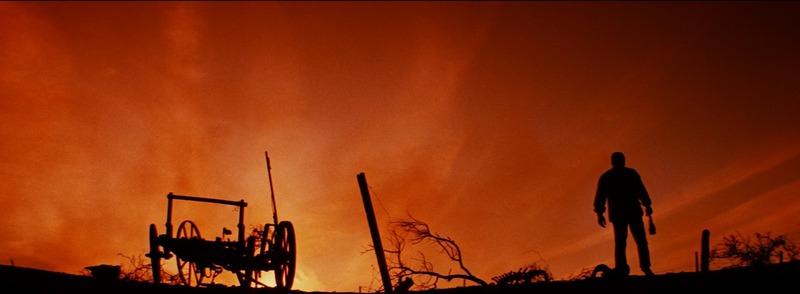
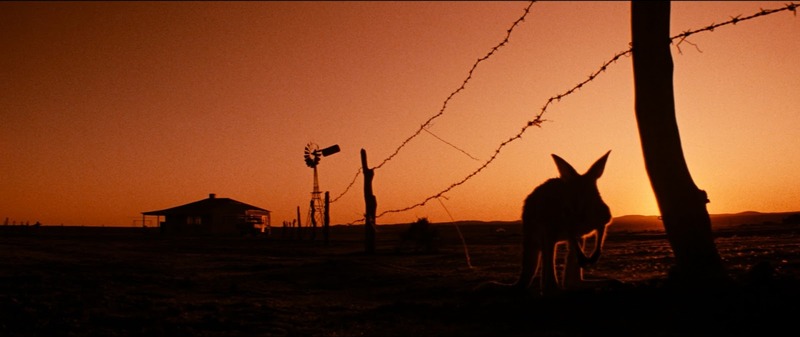
In the exterior scenes, Semler goes for extremely blue skies, often exposing in a way that recalls the Sunny 16 rule, then intensifying the effect with strong polarization, graduated filters and other tools. Continuity of light, or consistency from shot to shot, is not the priority. The priority is to obtain hot, graphic and attractive exteriors, even when the material being shown is ugly or unpleasant. There is also room for sunsets, sometimes real and sometimes created or pushed with color filtration. At certain points, the image is not merely stylized. As in the opening, it becomes openly hyperbolic.
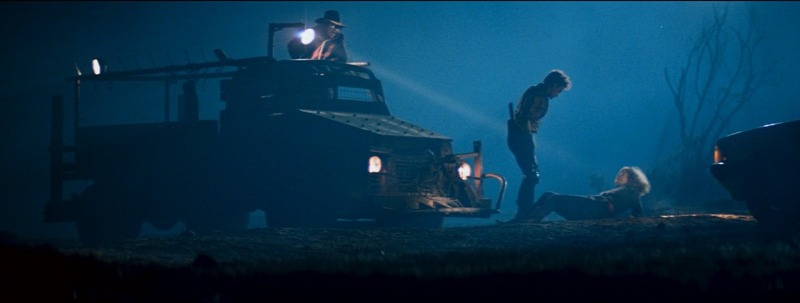
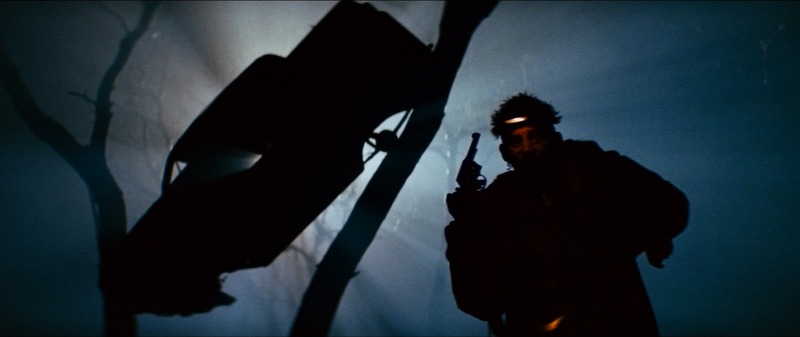
In interiors, Semler — very probably encouraged by Mulcahy — relies on shafts of light, smoke, solar effects and, at night, blue light projected from outside. There is no great coherence to this approach in a realist sense. The purpose is not to build a consistent lighting logic, nor even a stable aesthetic system. The image is designed to impress, to call attention to itself, and to give almost every frame some immediate graphic interest.
For that reason, in the middle of the night, Semler uses large units placed in heavy backlight, clearly hidden behind trees, vehicles, characters or objects, with very little concern for invisibility. In the early night scenes inside the car, the backlight feels almost outside the vehicle, practically entering the frame. Even in night scenes or sunset material, there are recreated suns or moons that produce extremely strange effects. The result is not naturalistic, but it is often technically fascinating as an exercise in pictorial force.
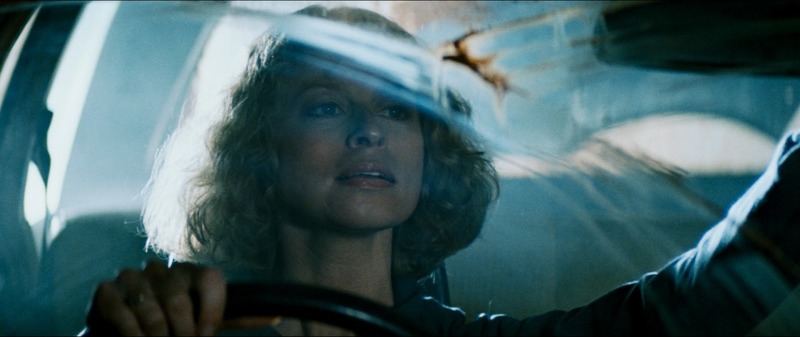
The monster itself is photographed almost entirely in tight shots, as if the filmmakers only had a mask or a partial construction that would not hold up in wider views. That, combined with editing that often ignores the raccord of positions and actions, creates an even stranger sensation. If the intention is to frighten or unsettle the audience, the film does not really achieve it. There is no spatial clarity, no sustained suspense, no precise sense of distance. One rarely knows where anything or anyone is in relation to the threat.
This is where the film’s visual intelligence and its dramatic weakness separate most clearly. As isolated frames, many images are remarkable. As a sequence of actions, they often refuse the basic information that genre cinema needs in order to generate tension. A monster movie depends on geography: where the creature is, where the victims are, what can be seen, what remains hidden, and how much time the characters have. “Razorback” often replaces that structure with impact cutting and graphic spectacle.
Conclusion
For all these reasons, even though many of the images are, when considered separately, extremely striking and interesting — and the film is also shot in anamorphic widescreen with Panavision lenses — “Razorback,” as cinematic narration, is severely flawed. In a music video, a singer can change position or location from one shot to the next without consequence, because the music provides the continuity. In narrative cinema, space, position and the viewer’s ability to locate the action matter much more.
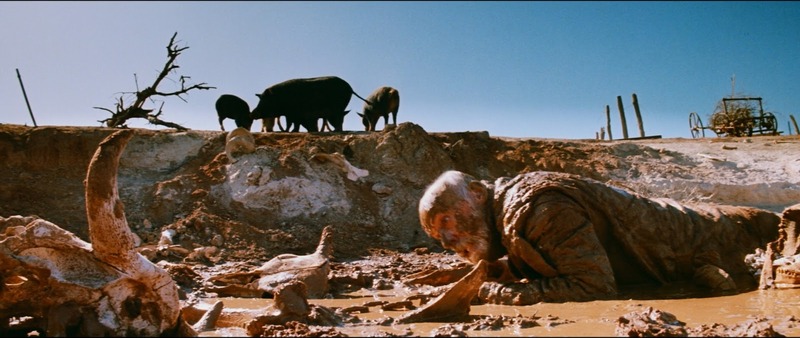
Without that, “Razorback” remains a failed exercise in style that nevertheless contains images that are often admirable on their own terms. It is visually memorable, technically bold and frequently exasperating as drama. That contradiction is probably the reason the film still attracts attention: its cinematography is much more accomplished than the film that contains it.
ON FILM & DIGITAL
© Ignacio Aguilar, 2026.
This article is part of ON FILM & DIGITAL’s English-language cinematography reviews and essays.
These texts are not plot summaries or general film reviews, but cinematography-focused essays written from the perspective of a working cinematographer.
The Author
Ignacio Aguilar is available for cinematography work, creative collaborations, lectures, workshops and international projects. He is a Sony Independent Certified Expert (ICE) and Cooke Optics Spanish Ambassador for Cooke SP3 lenses. Contact here.