

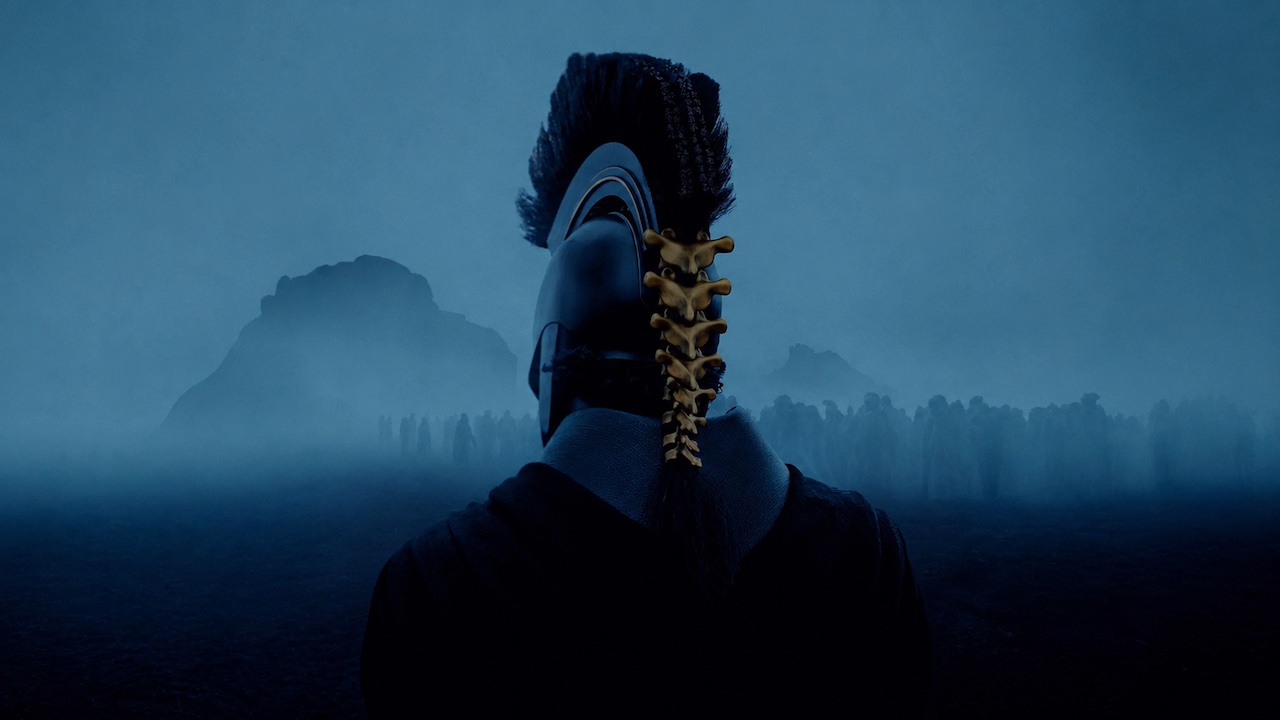
«The Odyssey»
Spanish title: La Odisea
Year of Production: 2026
Director: Christopher Nolan
Cinematographer: Hoyte Van Hoytema, ASC, NSC, FSF
Lenses: Panavision Sphero, Hasselblad
Film Stock: Kodak 5201 (50D), 5213 (200T), 5207 (250D), 5219 (500T)
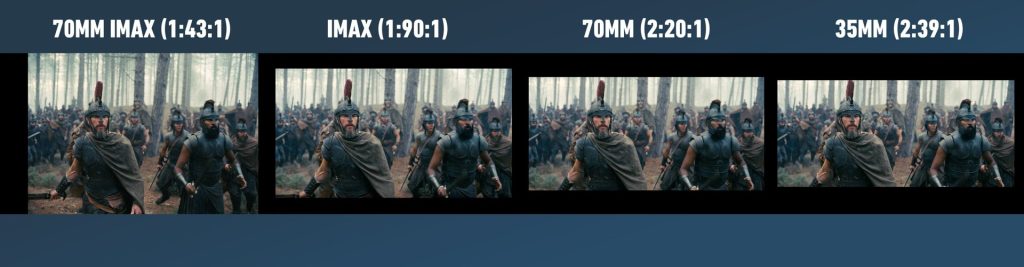
Format and Aspect Ratio: 15-perf 65mm (IMAX), 1.43:1
Other Versions: IMAX Digital (1.90:1), 70mm (2.20:1), 35mm 4-perf (2.39:1), DCP Flat (1.85:1), DCP Scope (2.39:1)
Hoyte Van Hoytema brings Nolan’s IMAX practice to its most ambitious form, but the film’s photochemical purity also makes its exposure choices unusually visible.
The Film
Christopher Nolan’s “The Odyssey” adapts Homer’s poem as a large-scale epic set years after the Trojan War. Odysseus (Matt Damon) is trying to return to Ithaca after the conflict, while his wife Penelope (Anne Hathaway) and his son Telemachus (Tom Holland) face the political and emotional consequences of his long absence. As expected from Nolan, the story is not told in a straight line. The film moves between the present in Ithaca and the long account of Odysseus’ journey after leaving home.
Including, of course, the events of Troy and the episode of the wooden horse. In broad terms, the result is ferocious: Nolan pushes the film forward from the first frame, with loud music, heavy sound design and a narrative structure that gives the audience almost no breathing room.
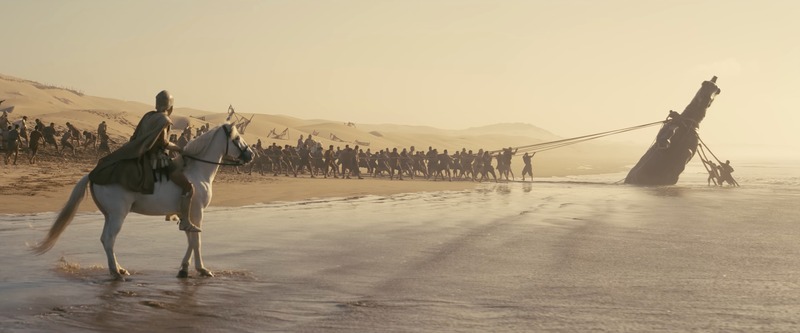
Using the full apparatus of a major studio superproduction, he achieves some truly memorable passages, especially everything involving the horse. At the same time, the sheer scale and the pace Nolan imposes leave relatively little room for emotion and character. Whenever the characters express feeling, it often seems as if two or three other things are already happening around them.
Although the film can be overwhelming, every dollar spent is visible on the screen, and its nearly three-hour running time goes by very quickly. It may not be as deep or as emotionally precise as “Oppenheimer” (2023), or even “Inception” (2010), but it remains a formidable theatrical object. Charlize Theron, Lupita Nyong’o, Robert Pattinson, Elliot Page, Jon Bernthal, John Leguizamo, Zendaya, Himesh Patel, Mia Goth and Benny Safdie, among others, complete the large ensemble cast.
The Cinematographer
The cinematographer is again Hoyte Van Hoytema [ASC, NSC, FSF], who has been Christopher Nolan’s regular collaborator since “Interstellar” (2014). Together they have made “Dunkirk” (2017), “Tenet” (2020) and “Oppenheimer” (2023), for which Van Hoytema won both the Academy Award and the ASC Award.
Van Hoytema first came to international attention through two films directed by Tomas Alfredson: “Let the Right One In” (2008) and “Tinker Tailor Soldier Spy” (2010). In the United States, he went on to photograph “The Fighter” (David O. Russell, 2010), “Her” (Spike Jonze, 2013) and the James Bond film “Spectre” (Sam Mendes, 2015).
Since becoming Nolan’s regular cinematographer, he has worked almost exclusively with him in features, while maintaining a presence in high-end commercial work. “Ad Astra” (James Gray, 2019) and “Nope” (Jordan Peele, 2022) are the main exceptions of recent years.
The Format and the 70mm Presentation
The technical specifications of “The Odyssey” are among the most discussed of any recent studio film. Since Nolan began using IMAX for large sections of “The Dark Knight” (2008), every one of his films except “Inception” has used the format in some form. Until now, however, there was a fundamental limitation: the mechanical noise produced by 15-perf 65mm IMAX cameras made direct sound dialogue extremely difficult.
For that reason, Van Hoytema, like Wally Pfister before him, had to combine IMAX with other formats: 35mm anamorphic up to “Interstellar,” and 5-perf 65mm on “Dunkirk,” “Tenet” and “Oppenheimer.” For “The Odyssey,” the filmmakers had a new, quieter IMAX camera built for them —the Keightley— and the scale of the production made it possible, for the first time in a fiction feature, to shoot the entire film in IMAX.
Only a small number of theaters worldwide can present the film natively in 15-perf 70mm —around 40, at 1.43:1. The film was also prepared for IMAX Digital at 1.90:1, conventional 5-perf 70mm at 2.20:1, 35mm 4-perf at 2.39:1, and standard digital exhibition in either Flat or Scope, depending on the theater.
This review refers specifically to a 5-perf 70mm screening. According to the available information, the film prints appear to follow an essentially photochemical workflow, including photochemical timing, except for the shots involving digital visual effects, which Nolan typically tries to minimize.
Further technical reading
For a broader explanation of IMAX, 65mm, 70mm, 35mm and aspect-ratio differences, see the Film Formats Guide.
For more on film stocks, exposure, density, latitude, printing and Digital Intermediate workflows, see the Guide to the Motion Picture Negative.
Visually, “The Odyssey” is also an imposing film. It includes locations in Morocco, Greece and Iceland, as well as extensive stage work built for the production. Above all, it is imposing because it is photographed at a huge scale. IMAX is used for extremely wide, highly detailed images: aerial views, distant wide shots, and, just as importantly, many close or near-close views of the characters.
The definition, even in the optical reductions to conventional 70mm, is very strong and clearly beyond what even the best 35mm projection can deliver. There is some flicker, as one expects in an analog projection, but the print is very stable and is certainly capable of producing deep blacks —a point I will return to later.
At the same time, the multi-format exhibition strategy seems to affect the framing. Characters are often placed near the center of the image, as if the composition had to serve both the full peripheral field of real IMAX and the narrower 2.20:1 or 2.39:1 versions. The result is sometimes a certain actorly isolation in the frame, and a reduced sense of over-the-shoulder interaction or classical blocking.
Visual Style Analysis
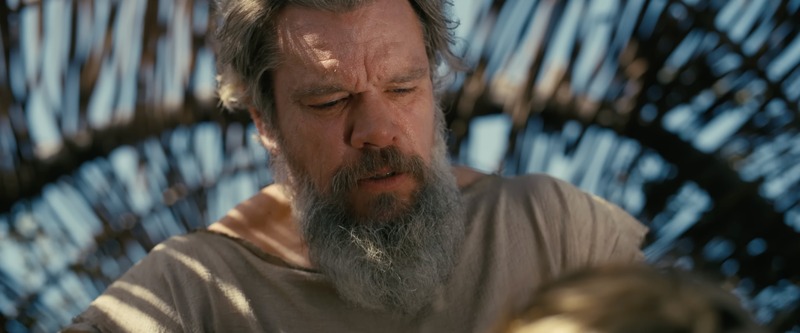
One of the limitations of Nolan’s cutting style is that the shots often remain on screen for very little time. Large format contains an enormous amount of visual information, but the viewer is not always allowed to explore it. Nolan is not making a “Lawrence of Arabia” (David Lean, 1962) or “2001: A Space Odyssey” (Stanley Kubrick, 1968) in the sense of holding grand large-format compositions long enough for the eye to wander through them. In “The Odyssey,” information is not so much discovered by the viewer as thrown toward the viewer through accumulation: image, cut, sound, music and movement. Nolan has often been criticized for a fragmented approach in which camera blocking and actor placement can feel somewhat loose or worked out under pressure. This film will not change the mind of those who already feel that way. Those who respond to his method will probably respond to it here as well.
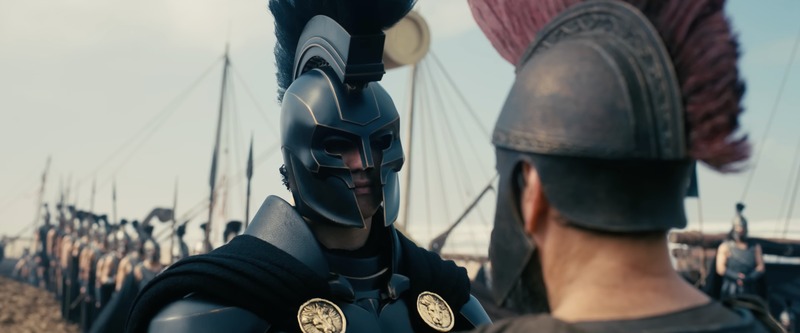
IMAX also means very shallow depth of field. Shooting at T/4 in IMAX is, roughly speaking, comparable to shooting around T/1.4 in 4-perf Super 35 in terms of depth of field. This sometimes affects focus —notably when Anne Hathaway moves repeatedly from background to foreground— and it also affects the sense of depth. On a large screen, it can be slightly strange to see so much of the image falling out of focus. Despite the large budget, and the exceptional resources presumably available to the filmmakers, both “Oppenheimer” and “The Odyssey” reveal the speed at which they were made. That was already visible in the previous film, and perhaps even more so here. Van Hoytema often lights —for instance in day interiors— with a broad, general approach rather than optimizing every individual shot, which is not necessarily how one expects a major Hollywood production to look.
This is not a problem in itself. It can be direct, truthful and realistic. But here the treatment of light feels uneven from scene to scene, and sometimes even creates continuity issues in exteriors. Some scenes feel as if certain imperfections were accepted, while other parts of the film are much more carefully controlled. Does that mean the film looks bad? Not at all. But it does not feel as technically and stylistically refined as one might expect from the scale of the undertaking. The exteriors tend to be stronger, partly because IMAX loves light. More light allows the lens to be stopped down, improves depth of field, improves optical performance and makes it possible to use slower, cleaner stocks such as 50D or 250D. That matters when the goal is maximum projection quality.
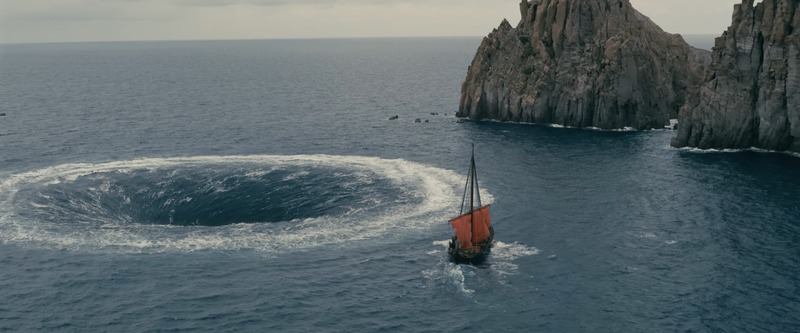
There are many beautiful sunsets, including the moment when the Trojans find and drag the horse, and several strong magic-hour scenes at sea. But this is not a cinematography style built around maximum contrast. Van Hoytema clearly exposes for the shadows, allowing very bright highlights, a great deal of white and a generally open image. That may also have allowed him to use less fill light and, once again, to move faster.
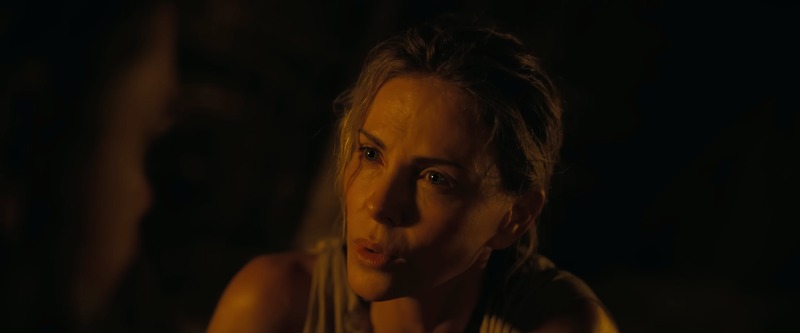
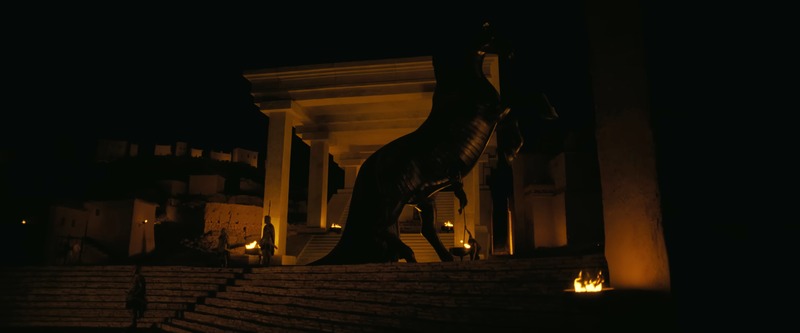
The night interiors, which imitate fire and torchlight already present in the frame, are, by contrast, the least interesting images in the film, and the ones that create the most problems even in 5-perf 70mm. On one level, they are repetitive: torches in frame, low-level orange light, a flickering effect across the actors’ faces, often with little variation from one location to another. More importantly, they reveal some of the consequences of Van Hoytema’s exposure choices. He was likely using 500T —Kodak 5219— and the exposure appears rather tight, if not slightly short. The effect produces the intended darkness, but in a photochemical print it creates a potentially serious issue: the density of the blacks.
One practical way to protect those blacks is to make sure that each low-light shot —especially if it is underexposed, or close to underexposed across most of the frame— contains some clearly overexposed element somewhere in the image. In this case, it could be a torch in the background, a fire in the foreground, or any strong luminous point that establishes a high exposure reference inside the frame. By contrast, almost automatically, the black becomes denser, stronger and richer. That is what one expects from large format in a photochemical projection.
On negative density and latitude
The variability of blacks in a photochemical print is easier to understand through exposure, negative density and printing. For more context, see the Guide to the Motion Picture Negative.
To place 15-perf 65mm, 5-perf 70mm and optical reductions within the history of large formats, see the Film Formats Guide.
“The Odyssey” often comes close to the dreaded look of a thin negative with milky blacks: blacks that are not quite black, but dirty, grayish, compressed and starved of shadow information. Large format should help a great deal with this, and in many shots it does. But the absence of a Digital Intermediate —even one used only for matching— makes the black level too variable and, in many passages, weaker than it could be. There are even dusk scenes in which the black almost disappears, either because the negative is short or because there is no overexposed element in the frame to anchor the print.
How do we know this is not a defective print or a projection issue? Because many shots do have dense blacks: not only exterior shots, but also isolated moments within the same torchlit scenes.
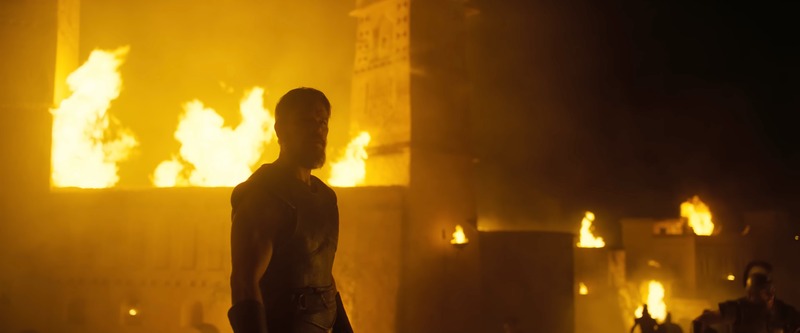
And when several torches or fires do appear in frame —even in the background, even occupying only a small area of the image— and they are properly overexposed, the blacks suddenly arrive. The fight in the climax is a clear example. Preserving rich, dense blacks in negative photography, as Vittorio Storaro did in the final section of “Apocalypse Now”, has always been one of the hardest things to achieve. Here, for whatever reason, it is not fully achieved. Kodak VISION3 stocks are relatively low in contrast, which does not help at this point. Nor do the Panavision Sphero lenses or the Hasselblad IMAX lenses necessarily help, since they are less contrasty than many modern lenses and can introduce a certain veiling level. But because “The Odyssey” sometimes shows dense black and sometimes does not, the issue does not seem to be only the stock or the optics. It is mainly one of exposure.
Final Thoughts
Does this ruin the experience? No. The film offers so many situations that do use IMAX and large format well that the screening remains extremely rewarding. The sharpness is remarkable, but the image remains natural and organic, with very little apparent grain and excellent skin tones. At times, it feels like a near-perfect mixture of digital cleanliness and detail with the more pleasant, physical quality of celluloid.
The experience of watching what appears, outside the necessary digital effects, to be an essentially photochemical process is genuinely exciting. The absence of a Digital Intermediate —the standard finishing process for more than twenty years— now feels like a rare object. A DI would almost certainly have hidden or improved some of the most problematic moments, but it is much more interesting to see a classical photochemical chain return to a major theatrical release, even if it carries some of the logical inconsistencies of the shoot into the final image.
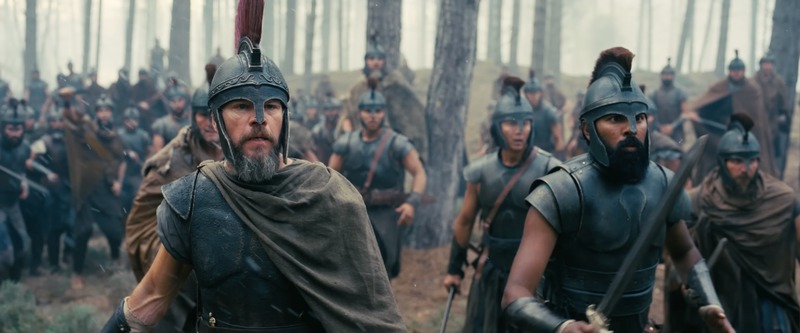
Leaving aside personal taste, idealized processes and the question of variable aspect ratios —in my view, once a film is composed for 2.20:1 or 2.39:1, those versions usually contain the essential information, while the more open versions add peripheral vision but not necessarily relevant dramatic content— the results are strong but uneven. The ambition to make a handmade studio epic, and to renounce the digital polish that now exists in almost every professional workflow, has a direct consequence: the exterior images can be spectacular, while the low-light scenes suffer more, without photochemical timing being able to correct everything.
In the end, the image is spectacular in conception, built on brutal scale and a very physical shoot. But the photochemical timing and printing process are merciless with variations in negative density, showing them in full rather than hiding them, and preventing the 70mm presentation from becoming an absolute reference point in image quality. The contradiction is that the film’s visual interest lies precisely there: in the photochemical process of shooting, processing and projection.
Seen in 5-perf 70mm (mk2 Cine Paz, Madrid, Spain)
ON FILM & DIGITAL
© Ignacio Aguilar, AEC, 2026.
The Author
Ignacio Aguilar, AEC is a cinematographer / director of photography based in Madrid, Spain. His work spans feature films, television, commercials and technical writing on cinematography, with experience in digital cinema, 16mm and 35mm film, anamorphic lenses, large-format digital capture, lens testing and film-based workflows. He is a member of the Spanish Society of Cinematographers (AEC) and the Spanish Academy of Cinema, a Sony I.C.E. Certified Expert and a Cooke SP3 ambassador. His writing has appeared in American Cinematographer and Camera & Light.
This article is part of ON FILM & DIGITAL’s English-language cinematography reviews and essays.
For professional work, collaborations, lectures, workshops or cinematography consulting, visit his professional biography, selected works or contact page.