

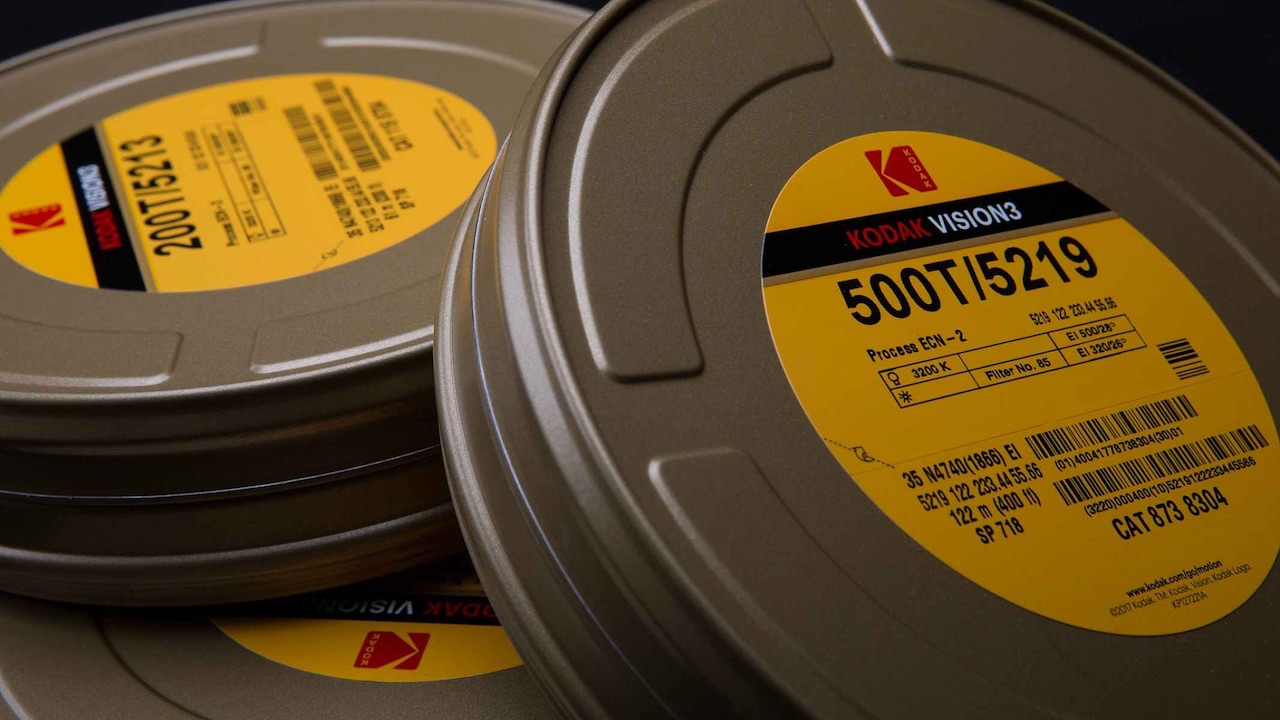
Guide to the Motion Picture Negative: Film Stock, Exposure, Processing, Scanning and DI
ON FILM & DIGITAL · Technical Guide
Guide to the Motion Picture Negative
Film cameras, film stock, 16mm and 35mm film formats, exposure, processing, scanning, Digital Intermediate and 4K restoration
By Ignacio Aguilar, AEC, cinematographer / director of photography
Spanish original: Guía del Negativo Cinematográfico
A motion-picture negative is the photographic record produced when film stock is exposed in the camera and then processed in the laboratory. This guide brings together a five-part series that follows that negative from the camera gate and film stock through exposure, density, processing, scanning, Digital Intermediate, preservation and 4K restoration.
The motion picture negative is not simply a texture, a layer of grain or an analog look. It is a complete image-making system. Camera, lens, format, gate, film stock, exposure, metering, density, processing, printing, scanning, color grading and archive all belong to the same chain.
That chain still matters in a digital environment. Many contemporary decisions in cinematography, color grading, restoration, film-emulation work, LUT design and format choice remain tied to the historical behavior of negative film: its highlight response, its grain structure, its latitude, its color separation and its relationship with the laboratory.
Series index
- Part I: The Motion Picture Camera, Film Stock and Color
- Part II: Format, Film Speed, Film Stocks and Grain
- Part III: Film Exposure, Light Metering, Density and Latitude
- Part IV: Processing, Printing and Laboratory Processes
- Part V: Scanning, Digital Intermediate, 4K Restoration and the Contemporary Workflow
Motion-picture negative workflow: camera, film stock, exposure, processing and scanning
The series is designed as a broad but technical introduction to the motion picture negative. It is not just an explanation of what film is, or why celluloid has grain. Its purpose is to organize the whole workflow: from the moment light passes through the lens to the point where the processed negative is scanned, turned into files, graded, archived or restored.
Part I
Motion-picture camera, film stock and color
The film camera, intermittent movement, shutter, gate, magazine, color negative stock, color temperature and correction filters.
Part II
Film format, film speed and grain
Negative area, format, ASA, Kodak, Fuji and Agfa stocks, grain structure, enlargement and the perceived sharpness of a film image.
Part III
Film exposure, light metering, density and latitude
Nominal ASA, Exposure Index (EI), overexposure, underexposure, negative density, latitude, highlight behavior, light metering, gray cards and spot meters.
Part IV
Film processing and the laboratory
Latent image, ECN-2, normal processing, push processing, pull processing, printing, printer lights, OCN, IP, IN and special laboratory processes.
Part V
Film scanning, Digital Intermediate and 4K restoration
Contemporary workflows, LOG files, dailies, proxies, Super 16mm, 35mm, practical cost references, preservation, Digital Intermediate and 4K restorations.
Original camera negative (OCN) and the final image
One of the central ideas of the series is that the original camera negative should not be mistaken for the finished image. It contains the photochemical information captured on set, but its final appearance depends on later stages: processing, printing, printer lights, duplication, scanning, digital grading and restoration.
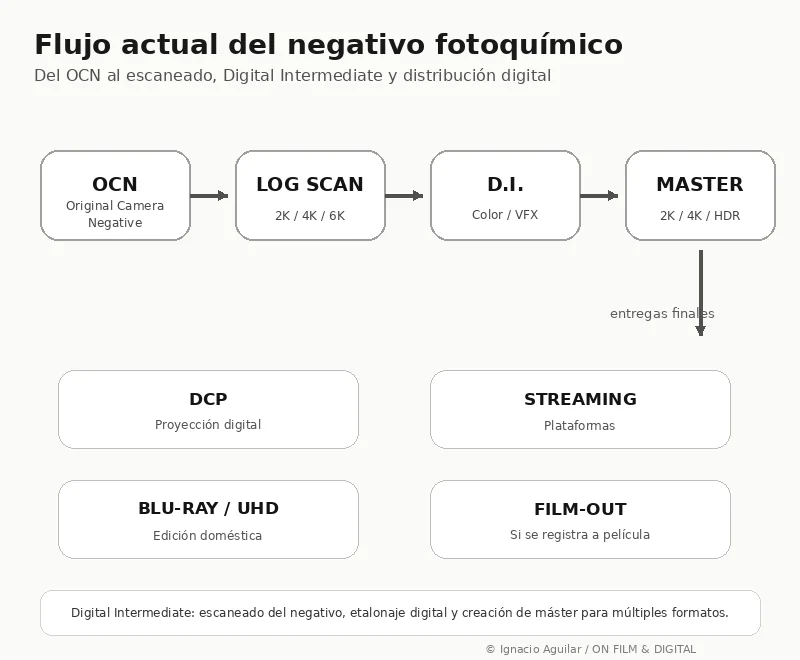
In a classical photochemical workflow, the visible image arrived through a positive print, with its own contrast, color, density and print texture. In a contemporary workflow, the negative is processed, cleaned and scanned. It then enters a digital environment of LOG files, dailies, proxies, conforming, Digital Intermediate, masters, DCPs, streaming deliverables, UHD releases and archive elements.
Basic chain
Camera → film stock → exposure → latent negative → processing → visible negative → photochemical printing / digital scanning → color grading → master / print / archive.
Why the motion picture negative still matters
Negative film is not inherently better or worse than digital capture. They are different systems. But the motion picture negative preserves a logic of its own, and that logic still shapes contemporary visual culture: how highlights are protected, how grain is formed, how color density is built, how shadows are perceived and how exposure, format and texture remain connected.
For a cinematographer, understanding the negative improves practical decisions even when the project is shot digitally. For a colorist, it clarifies why a photochemical image should not be treated like a digital camera RAW file. For a restoration team, it helps separate image information, historical fidelity and the appearance of a release print. For students and cinephiles, it offers a more exact way of looking at cinema.
Recommended reading path
For a first reading, the most useful route is to follow the five parts in order. The progression moves from the camera and the stock to exposure, then to the laboratory, and finally to the contemporary workflow of scanning, DI, preservation and restoration.
If the practical question is budget, Super 16mm, 35mm, scanning or current postproduction, start with Part V and then return to the earlier parts for the technical foundations.
Related reading
This guide connects with other ON FILM & DIGITAL articles on film formats, lenses, large format, anamorphic cinematography, restoration, photochemical texture and digital workflows.
- Film Formats Guide: 35mm, VistaVision, 70mm, IMAX and Large-Format Cinema
- Film Formats (I): 35mm, Silent Cinema, Sound and Technicolor
- Film Formats (II): Cinerama, CinemaScope and Panavision
- Film Formats (III): Academy Ratio, VistaVision and 70mm
- Film Formats (IV): Technirama, Techniscope and IMAX
- Full-Frame Cinema: A Practical Guide to Large Format and VistaVision
- Full-Frame Cinema: Lens Coverage, Crop Factor and the Large Format Look
- Cinematography Essays, Technical Guides and Film Reviews in English
Cinematography, education and technical consulting
ON FILM & DIGITAL combines film analysis, technical history and professional cinematography experience. For cinematography work, lectures, workshops, technical presentations, brand collaborations or projects involving cameras, lenses, film stocks and image workflows, contact Ignacio Aguilar AEC directly.
ON FILM & DIGITAL © Ignacio Aguilar, AEC · 2026