

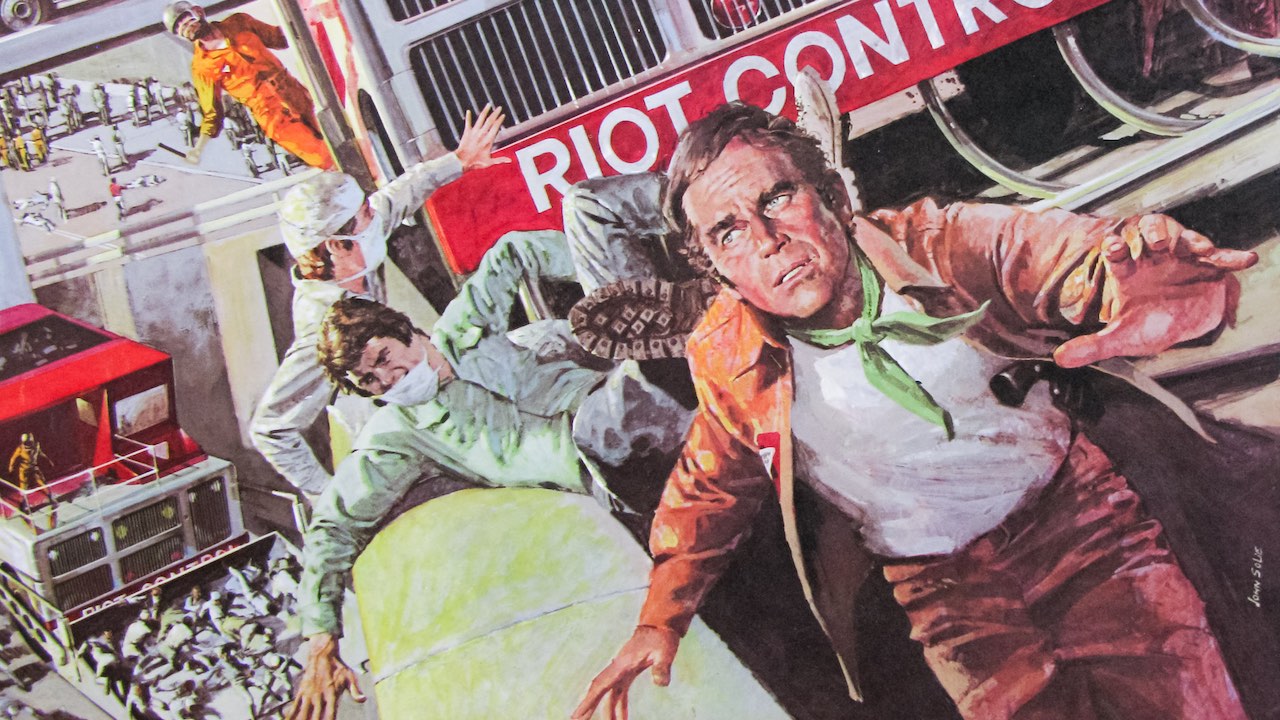
“Soylent Green”
Spanish Title: Cuando el destino nos alcance
Year of Production: 1973
Director: Richard Fleischer
Director of Photography: Richard H. Kline, ASC
Lenses: Panavision C Series, Super Panazoom Cooke
Film Stock: Kodak 5254 (100T)
Format and Aspect Ratio: 35mm anamorphic Panavision, 2.40:1
Viewed on: 4K HDR Blu-ray
A 1970s dystopia photographed between old-school Hollywood control and emerging modernism: Richard H. Kline, ASC in anamorphic Panavision.
The Film
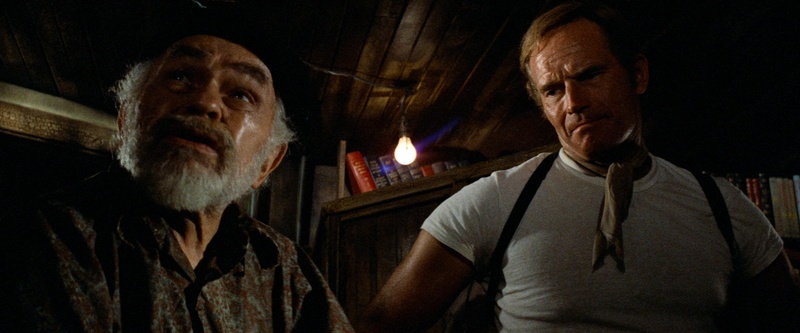
Based on Harry Harrison’s novel Make Room! Make Room!, Soylent Green imagines New York City in 2022 with a population of forty million. Large corporations dominate society, natural resources have been exhausted, and the greenhouse effect has turned heat and air pollution into a permanent physical burden. Charlton Heston plays a police detective investigating the murder of a wealthy man (Joseph Cotten), assisted by an elderly friend (Edward G. Robinson) who still remembers what life on Earth was like before this bleak period.
Soylent Green is pure 1970s dystopian science fiction, with both the virtues and limitations of that tradition. It is an oddly likable film, and its moving final section is difficult to forget. The screenplay is less secure in the mechanics of the investigation: Heston’s character often seems to encounter the evidence rather than actively uncover it, while the ultimate revelation is powerful but hardly subtle. Leigh Taylor-Young, Chuck Connors, Brock Peters, Dick Van Patten and Mike Henry complete the cast.
The Cinematographer
The cinematographer was American director of photography Richard H. Kline, ASC, a figure with deep roots in classical Hollywood. He was the son of cinematographer Benjamin H. Kline and worked his way up through the camera department before moving into television cinematography in the mid-1960s. Although he retired in the early 1990s, his strongest period ran from the late 1960s through the early 1980s. During those years he photographed five features for Richard Fleischer: The Boston Strangler (1968), Soylent Green (1973), The Don Is Dead (1973), Mr. Majestyk (1974) and Mandingo (1975).
His credits also include Camelot (Joshua Logan, 1967), which brought his first Academy Award nomination; The Andromeda Strain (Robert Wise, 1971); The Mechanic (Michael Winner, 1972); Battle for the Planet of the Apes (J. Lee Thompson, 1973); King Kong (John Guillermin, 1976), which brought his second Oscar nomination; The Fury (Brian De Palma, 1978); Who’ll Stop the Rain (Karel Reisz, 1978); Star Trek: The Motion Picture (Robert Wise, 1979); Body Heat (Lawrence Kasdan, 1981); Breathless (Jim McBride, 1983); and Howard the Duck (Willard Huyck, 1986), among many others.
Visual Style Analysis
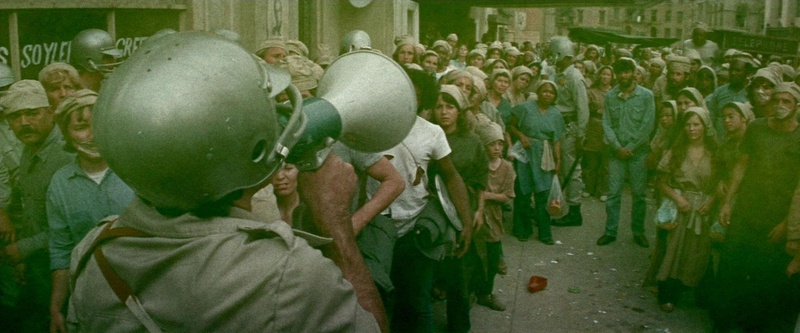
Soylent Green is ambitious in both setting and dramatic scope. The production does not look cheap, but its resources are clearly smaller than the scale of the world it is trying to create. The daytime exteriors are therefore among its most memorable elements. They present a nearly decayed, desperately overcrowded city whose infrastructure seems close to collapse.
To suggest the “greenhouse effect,” the filmmakers appear to have used a treatment that gives the exterior image a green cast, strongest toward the upper part of the frame and weaker below, almost like a graduated filter. From the finished image, the exact method is difficult to pin down. It often reads like post-production or optical work, while some sources describe a specially designed on-set filter intended to create both haze and the green coloration. The final effect may well involve a combination of techniques.
These exteriors, both day and night, were shot on the old MGM backlot in Culver City, California. Soylent Green is often cited as the last feature to use those streets before the property was sold. By then the backlot was in poor condition, and that physical deterioration worked in the production’s favor.
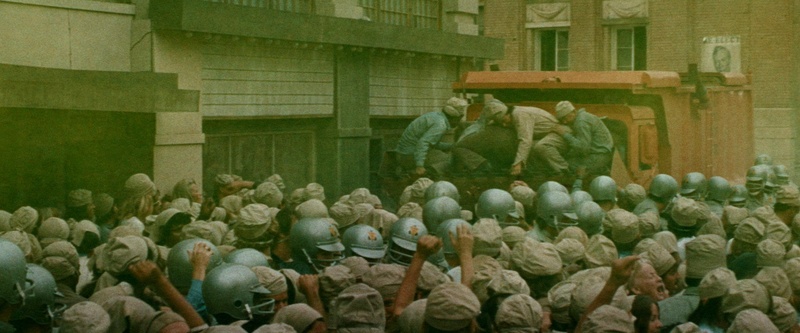
The limitation is that, despite the work of an accomplished art director such as Edward C. Carfagno, the streets rarely convince as actual New York. They still read as studio backlot spaces, both by day and at night. Matthew Yuricich contributes several excellent matte paintings; if anything, their quality exposes how much more scale the film acquires whenever they appear.
The relatively modest budget is also visible in Carfagno’s broader strategy. Rather than inventing a fully redesigned future, the film extends the life of contemporary 1970s objects and allows them to age: the cars in the streets are the clearest example. It is an economical and conceptually coherent approach. It was certainly more achievable than building an entirely new visual world in the manner that Blade Runner would attempt nine years later.
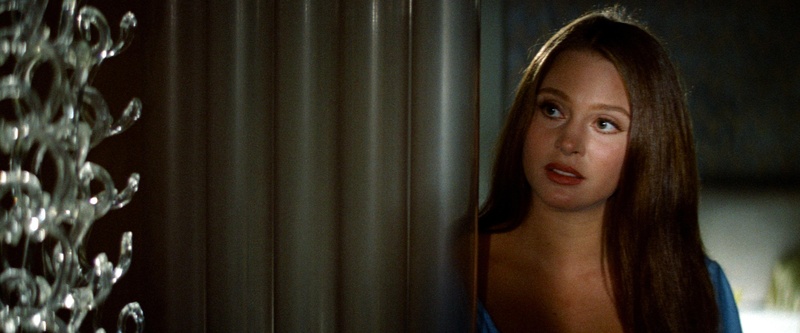
Purpose-built interiors are a different matter. In the apartment occupied by Joseph Cotten’s character, Kline repeatedly does work that is almost a textbook example of his style. Even when Fleischer wants to use the zoom — and does so several times — Kline allows practical fixtures in the bedroom, bathroom and hall to contribute genuinely to the exposure. He then layers soft light onto the actors, giving parts of the film a modernity that the larger production design cannot always sustain.
At other moments, however, Kline falls back on his classical instincts and uses hard light. Leigh Taylor-Young’s close-ups are the clearest example. She is photographed with an almost porcelain finish, entirely appropriate for a character who is effectively presented as part of the luxury apartment itself.
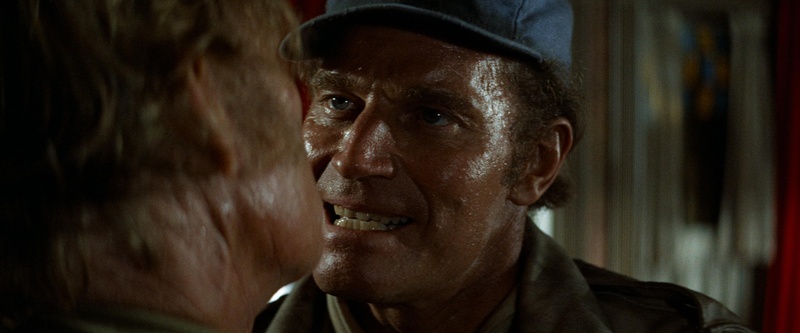
That tension between soft and hard light runs through the entire film. Kline seems drawn to softer sources whenever the set and scene allow them, yet he is also photographing what is essentially a thriller inside a science-fiction framework. Shooting anamorphic, he still wants contrast, depth and separation. Hard, precisely placed sources therefore return throughout the picture, creating dense shadow areas and giving the frame a stronger sense of depth.
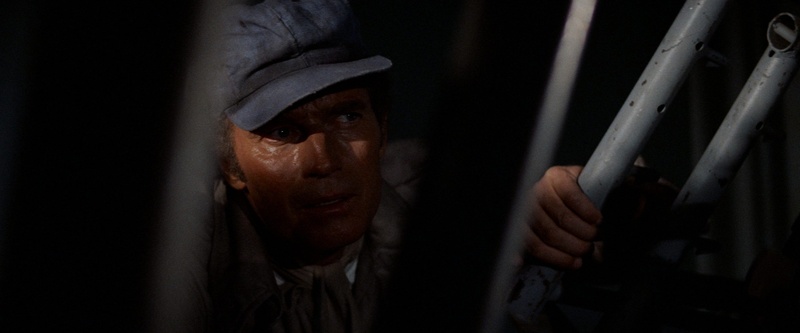
The factory and church sequences near the end show this hybrid approach most clearly. Blue fluorescent practicals collide with larger units, hard directional light and blue backlight. The lighting does not attempt to disappear. Instead, integrated sources and traditional movie lighting coexist within the same visual system.
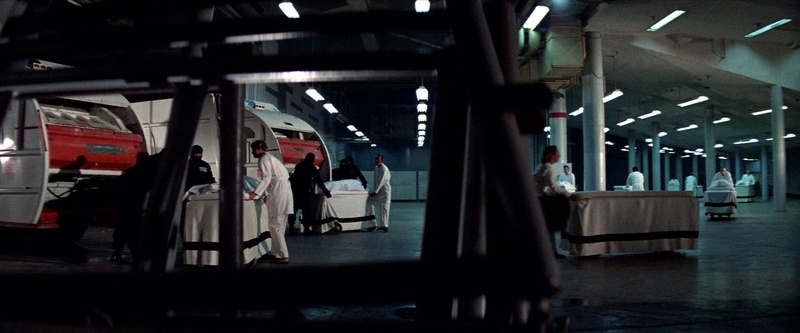
Kline also uses a number of carefully chosen, almost hidden split-diopter shots to extend apparent depth, a device he had already used extensively in The Andromeda Strain and would use again in Star Trek: The Motion Picture. In some late sequences, the light levels appear extremely low and the anamorphic lenses seem to be working very close to maximum aperture. That raises an interesting technical question: are we looking at Panavision C Series lenses opened all the way — roughly T2.3 depending on focal length — or at some faster experimental Panavision glass? The later Super High Speed series, which opened to approximately T1.1 and which Kline used on King Kong, did not appear until 1976.
Conclusion
In less experienced hands, this constant negotiation between modernity and classicism could easily have become stylistically incoherent. With Kline it feels organic, largely because the contradiction was already part of his photographic language. He could resemble Owen Roizman or Gordon Willis in one scene, then Harry Stradling or Charles Wheeler in the next. More importantly, he had the technical control to work at low light levels with anamorphic lenses close to wide open, then raise the exposure enough to bring an anamorphized zoom into play without making the transition feel disruptive.
The scale of Soylent Green is ultimately smaller than the world its premise requires. Yet Fleischer’s assured staging and Kline’s hybrid visual approach keep the film consistently interesting. It remains unmistakably a product of the 1970s, but there are flashes of a more modern photographic language throughout. From a contemporary perspective they may not be radical, yet in 1973 they were probably enough to make the film feel contemporary. That may also help explain the lasting affection for a movie that is somewhat uneven as a thriller but contains moments that remain unforgettable.
The new 4K Blu-ray generally shows excellent image quality whenever the restoration can return to the OCN, the original camera negative. Fades, dissolves and the probable optical work used to create the characteristic green greenhouse-effect treatment show the expected drop in image quality, although the result remains distinctly filmic.
ON FILM & DIGITAL
© Ignacio Aguilar, 2026.
This article is part of ON FILM & DIGITAL’s English-language cinematography reviews and essays.
These texts are not plot summaries or general film reviews, but cinematography-focused essays written from the perspective of a working cinematographer.
The Author
Ignacio Aguilar, AEC is a cinematographer / director of photography based in Madrid, Spain. His work spans feature films, television, commercials and technical writing on cinematography, with experience in digital cinema, 16mm and 35mm film, anamorphic lenses, large-format digital capture, lens testing and film-based workflows.
He is a member of the Spanish Society of Cinematographers (AEC) and the Spanish Academy of Cinema, a Sony I.C.E. Certified Expert and a Cooke SP3 ambassador. His writing has appeared in American Cinematographer and Camera & Light, and ON FILM & DIGITAL gathers his bilingual essays, technical guides and cinematography reviews.
For professional work, collaborations, lectures, workshops or cinematography consulting, visit his professional biography, selected works or contact page.
The Spanish-language archive is available at ON FILM & DIGITAL.