

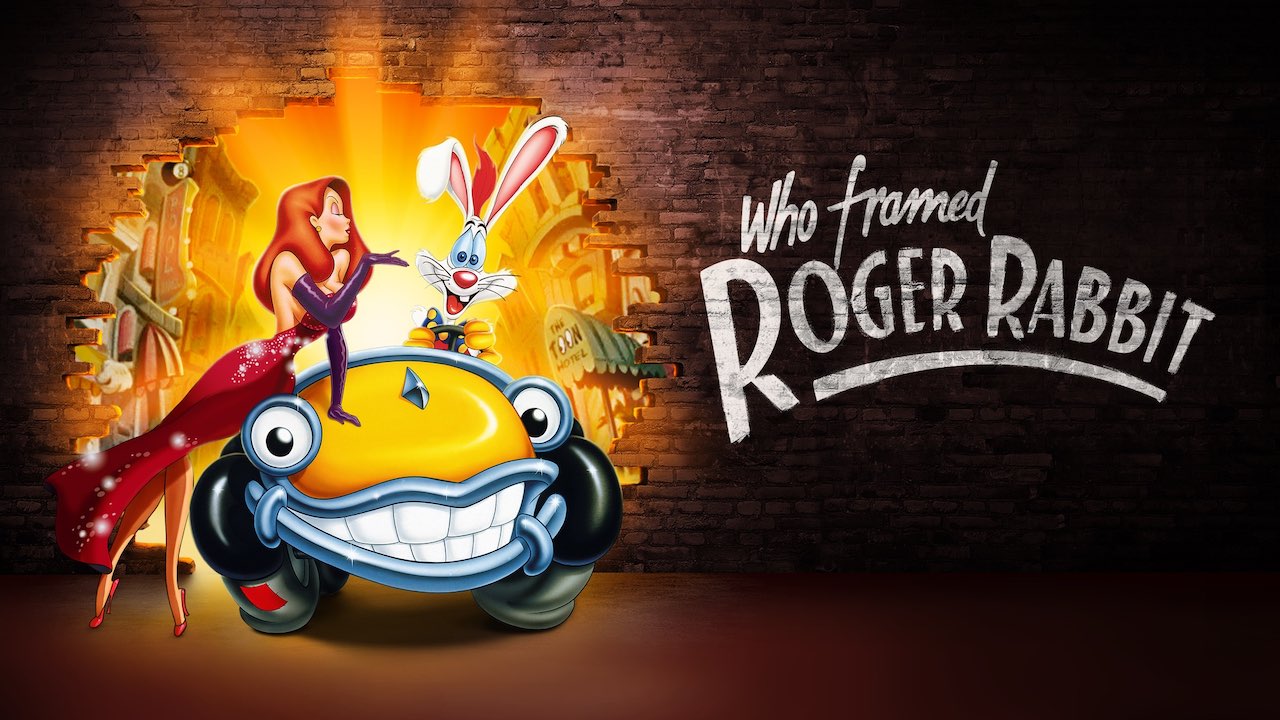
“Who Framed Roger Rabbit”
Spanish Title: ¿Quién engañó a Roger Rabbit?
Year of Production: 1988
Director: Robert Zemeckis
Director of Photography: Dean Cundey, ASC
Lenses: Panavision Ultra Speed MKII (35mm 4-perf), Nikon still lenses (VistaVision)
Film Stocks: Kodak 5247 (125T), Kodak 5297 (250D), Kodak 5294 (400T), Agfa XT-320
Format and Aspect Ratio: 35mm 8-perf (VistaVision) + spherical 35mm 4-perf, 1.85:1
Additional Photography: Paul Beeson, BSC
Awards: Academy Award nomination for Best Cinematography, BAFTA nomination, British Society of Cinematographers nomination
Dean Cundey, VistaVision and color noir for one of the most demanding live-action and animation achievements of 1980s Hollywood.
The Film
A film adaptation of Gary K. Wolf’s novel, “Who Framed Roger Rabbit” is set in Hollywood in 1947. With a plot that clearly echoes “Chinatown” (Roman Polanski, 1974), Robert Zemeckis made the film immediately after the success of “Back to the Future” (1985), and before moving on to its sequels. It was also one of the most expensive productions of the 1980s.
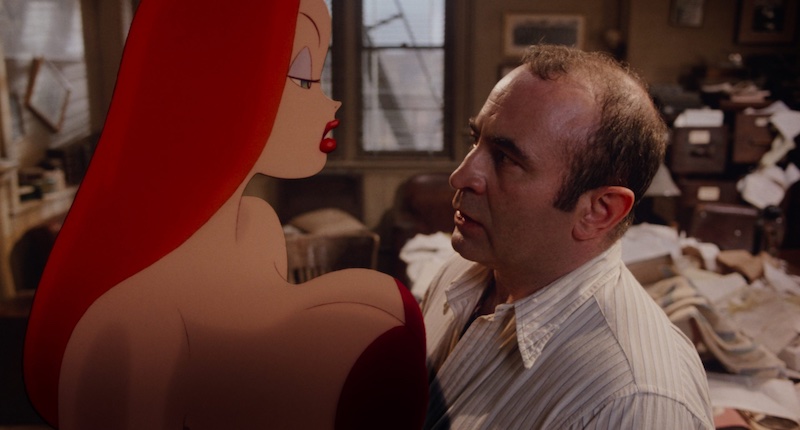
The story takes place in an imaginary world where human beings and cartoon characters coexist. Eddie Valiant (Bob Hoskins), a down-on-his-luck private detective, is hired to take compromising photographs of Jessica Rabbit, the wife of the famous cartoon star Roger Rabbit. When Valiant realizes that he has been used to frame Roger for murder, he begins his own investigation in order to clear him.
“Who Framed Roger Rabbit” was, and remains, a technical landmark for the extraordinary combination of live action and the animation supervised by Richard Williams. That achievement is not in question. What is more problematic is the film’s tone. It is neither fully a children’s film nor an adult one, and its frantic, noisy rhythm does work against the viewer’s ability to fully appreciate the work done by Cundey, Williams and the production team.
The production effort required to place so many “real” animated characters on screen — not only from Disney, but also from companies such as Warner Bros. — remains remarkable. Yet the film often overwhelms the viewer with its own energy. Joanna Cassidy and Christopher Lloyd round out the cast, while Hoskins carries the film almost entirely.
The Cinematographer
Although the film was shot mainly in the United Kingdom, the director of photography was the American cinematographer Dean Cundey, ASC, who at that time had become Robert Zemeckis’s preferred collaborator. Cundey had made his name through his work with John Carpenter on “Halloween” (1978), “The Fog” (1980), “Escape From New York” (1981), “The Thing” (1982) and “Big Trouble in Little China” (1986).
Cundey and Zemeckis first worked together on “Romancing the Stone” (1984). They also made the three “Back to the Future” films, released in 1985, 1989 and 1990, with the two sequels shot back to back. They later reunited for “Death Becomes Her” (1992), their final collaboration. From “Forrest Gump” (1994) onward, Zemeckis has worked mostly with Don Burgess.
While he was still working with Zemeckis, Cundey was also called upon by Steven Spielberg for both “Hook” (1991) and “Jurassic Park” (1993). He may simply have been unlucky that, on “Schindler’s List” (1993), Spielberg crossed paths with the Polish cinematographer Janusz Kamiński, with whom he has worked ever since. Cundey’s later filmography is less consistently interesting, although “Apollo 13” (1995) stands out. In recent years he has remained active, shooting, for example, episodes of “The Mandalorian” for television.
Visual Style Analysis
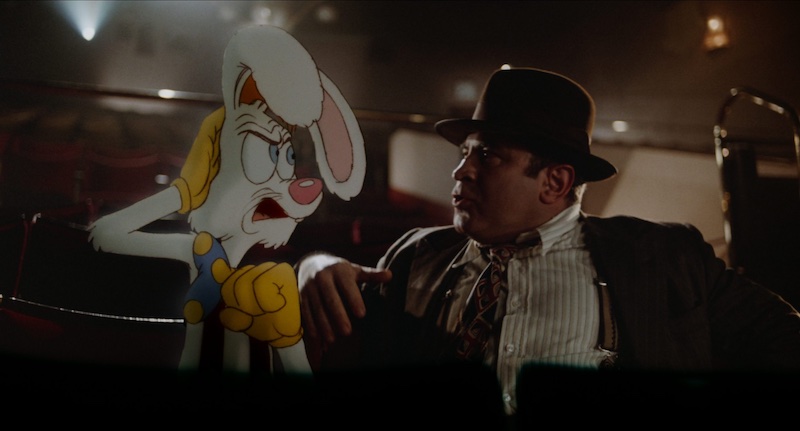
“Who Framed Roger Rabbit” was one of the most technically complicated productions of its period. Without access to the digital tools that would arrive in cinema only a few years later, the filmmakers had to combine live actors, physical sets and hand-drawn animated characters with a high degree of precision. During production, that meant shooting plates in which everyone had to know where the animated characters would later be placed, what they would do, and how the live-action image would serve as the foundation for the animators.
The animators then had to draw, animate and adjust their characters to the lighting logic of the photographed scene. With more than a thousand effects shots to integrate, every sequence required careful planning. The crew had to know in advance which shots would include animation effects and which ones would not.
Industrial Light & Magic, then the most prestigious visual-effects company in the industry, was also involved. One of the major advances introduced for “Who Framed Roger Rabbit” was the construction of a new camera for all shots requiring postproduction effects. Because the VistaVision camera would need to record a significant amount of sync sound, ILM built the VistaFlex, a camera quiet enough to shoot dialogue.
VistaVision
For a practical guide to the format, its negative area and its current large-format legacy, see Full-Frame Cinema: Large Format and VistaVision.
Like earlier cameras for the format, the VistaFlex used Nikon still-photography lenses. This time, however, they could be operated with a follow-focus system, unlike the earlier EmpireFlex camera, which generally used fixed focus, or focus adjustments made by hand. Material without effects was shot in conventional 4-perf 35mm, while the effects and animation were integrated into a master interpositive through optical compositing. The idea was that the larger negative area of VistaVision — roughly twice that of standard 35mm — would prevent the degradation caused by optical duplication from becoming obvious when matched with the regular 35mm negative. Cundey estimated that 80 percent of the film was shot in VistaVision.
The result, at least as preserved in the current 4K Blu-ray, is remarkable. That edition derives from two sources: a scan of the original 35mm negative for the non-effects scenes, and the master positive element, a second-generation source, for the shots with integrated visual effects. The compositing in many scenes is exceptionally clean, with very few shots in which image quality visibly drops because of the effects work.
In that sense, it is striking how much more refined the optical work and integration are here than in the two “Back to the Future” sequels, where the loss of quality whenever a character is duplicated is far more evident, even though those films were shot later. In “Who Framed Roger Rabbit,” the most widely used negative stock was the classic Kodak 5247 (125T), both for the VistaVision material and the standard 35mm footage, although the film also includes some 5294 (400T, with more grain) and 5297 (250D). Interestingly, the entire ending had to be shot on Agfa XT-320, because the filmmakers needed a stock faster than 5247 but less grainy than 5294. The pastel, low-contrast Agfa look is not particularly evident on screen, most likely because Cundey overexposed it in order to bring it closer to the more contrasty and saturated look of 5247, with stronger blacks.
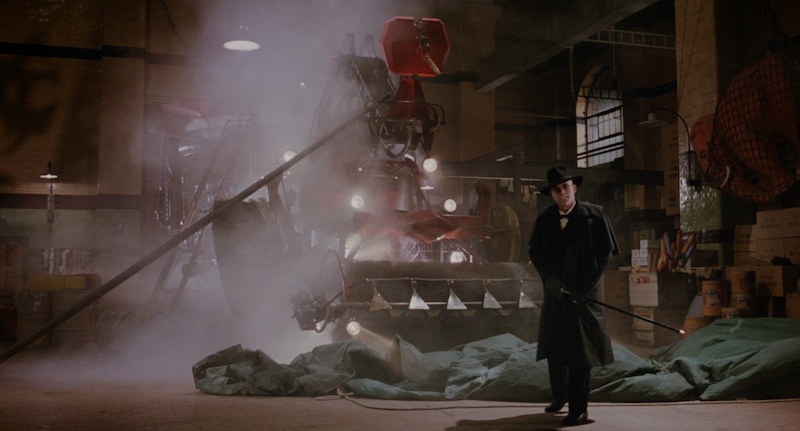
Beyond the complexity of shooting so much of the film in VistaVision, the filmmakers also had to recreate Hollywood in the United Kingdom. They benefited from the production design of Elliot Scott, known for “Dragonslayer” and “Indiana Jones and the Temple of Doom”, as well as from a brief period of location shooting in Los Angeles. The result is convincing enough that the film never feels obviously British-made.
Visually, “Who Framed Roger Rabbit” is a relatively bright film, but its makers were clearly pursuing a color-noir aesthetic, with echoes of classical Technicolor photography. The colors are intense and saturated, and this comes through very well on screen. That noir approach often implies hard light and visible shadows within the set — Venetian-blind shadows, for instance — and Cundey seems very comfortable working with them.
There is also a notable use of neon light, sometimes supported by intense reds that wash parts of the set. The look is sophisticated and relatively believable, or at least believable enough for a film of this kind. More importantly, that color-noir aesthetic does not merely evoke 1940s Hollywood. It gives the animators a consistent base of light and shadow that helps make the cartoons credible inside the live-action world.
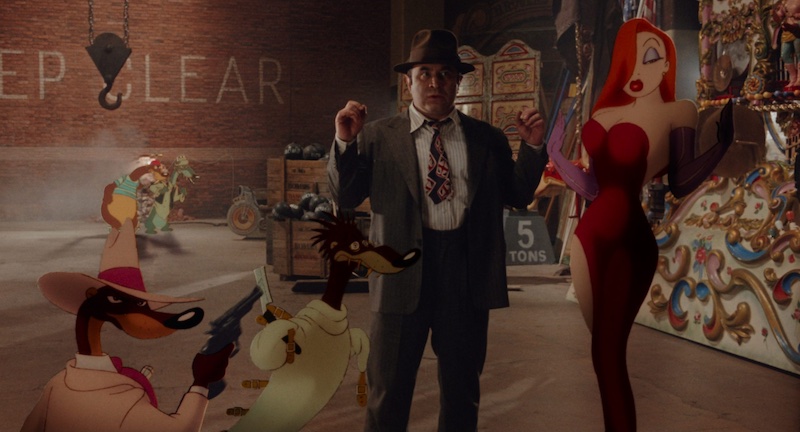
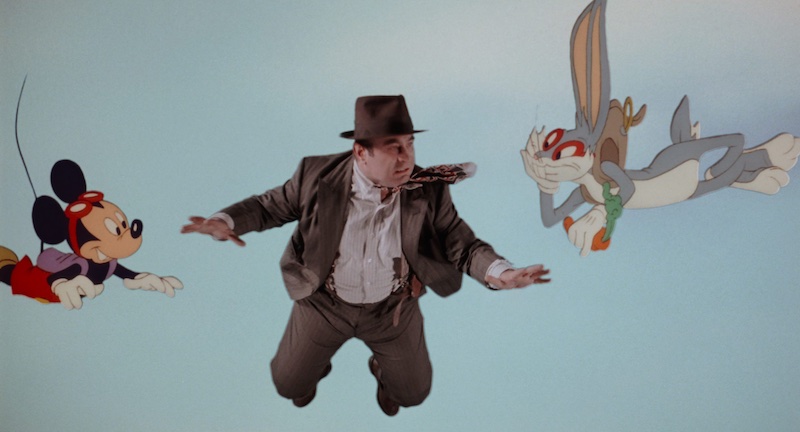
The achievement is not simply that live actors and cartoons were integrated on screen; that, in itself, was not new. What makes the film exceptional is the way the animated characters were lit, shaded and made to respond to the photographed world. Their shadows and other lighting interactions were added in postproduction, giving the fusion between live action and animation a level of credibility that remains extremely effective on the big screen.
The viewer never forgets that these are cartoons, but the world flows with remarkable ease. Zemeckis’s willingness to move the camera also contributes to the dynamism of the integration. Curiously, the more problematic shots tend to be those in which live-action characters enter the animated city of Toontown — in other words, when there is only one real character and everything else is animation. In those scenes, ILM’s blue-screen matte work is more visible.
Final Thoughts
The results, technically, are outstanding. Nearly four decades after the film was shot and released, there are still very few areas in which the work can be seriously criticized. This is partly the result of the money spent on the production. Money buys time: time to test, to build the necessary tools for the shoot, including the VistaFlex camera, and to carry out a long, highly precise production.
But the film’s visual design is also interesting and enduring, both in its choice of color noir and in the way Dean Cundey implements that approach. It may not be his best work, nor his most spectacular or his most daring. But it allowed him to demonstrate both his talent with light and his considerable technical skill, qualities that made him Hollywood’s leading specialist when it came to photographing films with extensive postproduction visual effects, especially those that required many technical solutions to be implemented during the shoot itself.
For that reason, he received the only Academy Award nomination for cinematography of his entire career, losing to Peter Biziou for “Mississippi Burning” (1988). He was also nominated for the BAFTA and for the British Society of Cinematographers award. Curiously, however, his peers at the American Society of Cinematographers did not nominate him for their award, something they would later do for “Hook” and “Apollo 13”.
Viewed on 4K HDR Blu-ray
ON FILM & DIGITAL
© Ignacio Aguilar, 2026.
This article is part of ON FILM & DIGITAL’s English-language cinematography reviews and essays.
The Author
Ignacio Aguilar is available for cinematography work, creative collaborations, lectures, workshops and international projects. He is a Sony Independent Certified Expert (ICE) and Cooke Optics Spanish Ambassador for Cooke SP3 lenses. Contact here.