

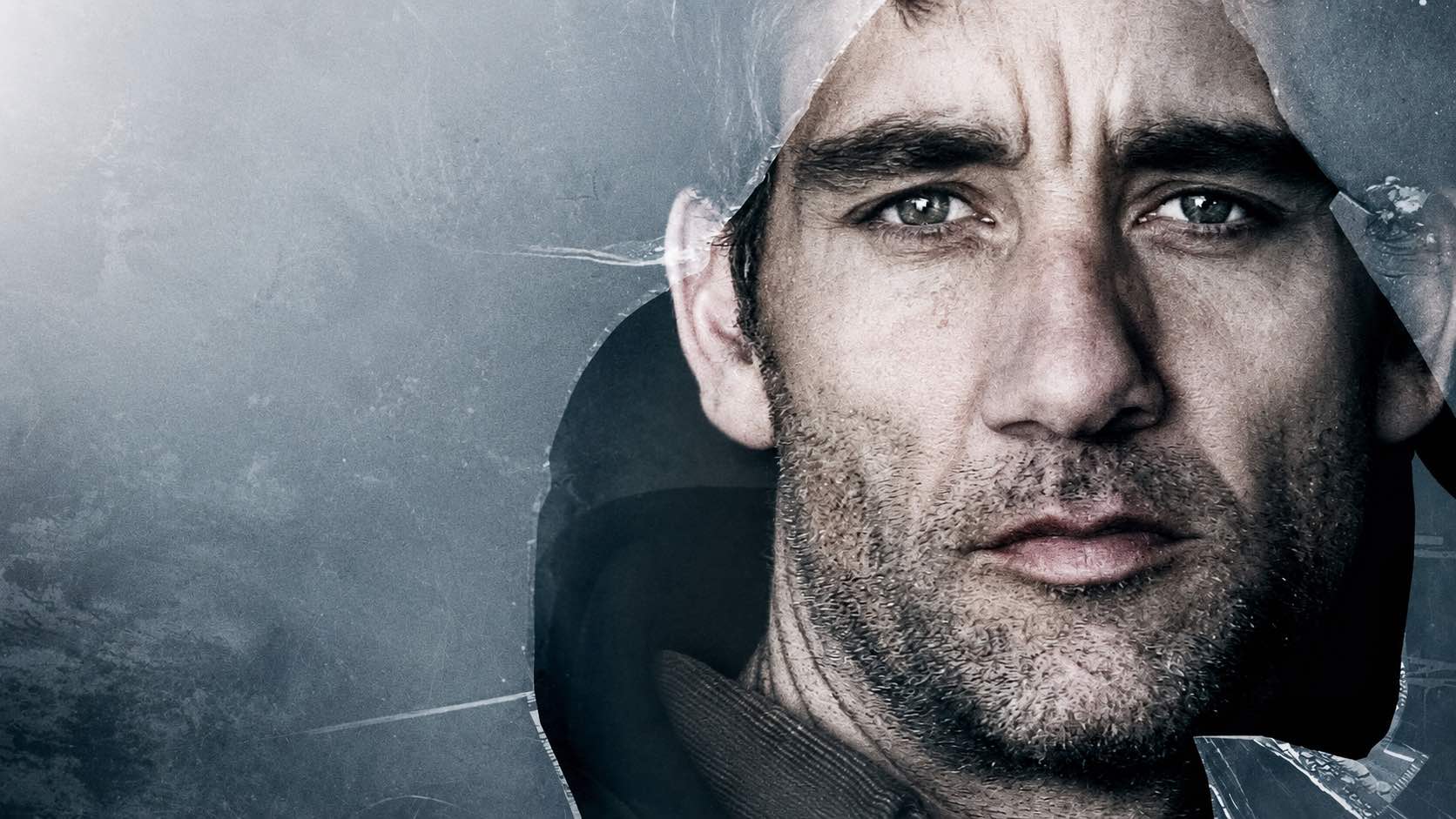
Children of Men
Spanish Title: Hijos de los Hombres
Year of Production: 2006
Director: Alfonso Cuarón
Cinematographer: Emmanuel Lubezki, ASC, AMC
Lenses: Arri/Zeiss Master Primes
Film Stock: Kodak VISION2 Expression 5229 (500T)
Format and Aspect Ratio: Super 35, 1.85:1
Other: 2K Digital Intermediate
Awards: Academy Award for Best Cinematography (nomination), American Society of Cinematographers Award, BAFTA Award, British Society of Cinematographers Award (nomination)
Emmanuel Lubezki, ASC, AMC turns Children of Men into something felt in the body: handheld wide lenses, available light, Kodak 5229 and a future that seems disturbingly close.
The Film
A brilliant film adaptation of P.D. James’s novel, directed by Mexican filmmaker Alfonso Cuarón. Set in the near future, in the year 2027, Children of Men imagines a world in which humanity has lost the ability to reproduce. Society has fallen into chaos. Theo (Clive Owen) numbs himself with alcohol until he is contacted by his ex-wife (Julianne Moore), an activist — perhaps a terrorist — who asks him to help her group obtain transit papers for a young woman who, miraculously, is pregnant.
The film stands out for many reasons, but perhaps above all for its conception of the future. This is not a dystopia that feels like science fiction. It feels immediate, tangible and almost already here. The screenplay may not be on quite the same exceptional level as the direction, the visual strategy and the performances (Michael Caine, Chiwetel Ejiofor, Charlie Hunnam, Peter Mullan), but what Cuarón tells, and the way he tells it, makes Children of Men a remarkable film of considerable narrative force. Above all, it works as an immersive experience.
The Cinematographer
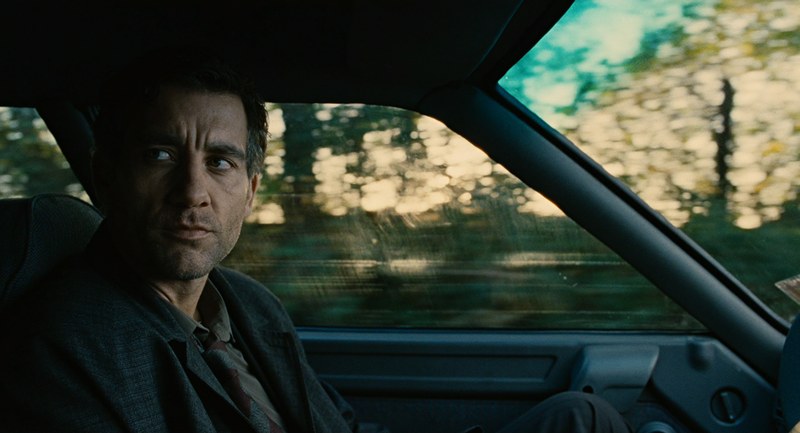
The cinematographer was Emmanuel Lubezki, ASC, AMC, a fellow Mexican and one of Alfonso Cuarón’s essential collaborators. Together they shot Sólo con tu Pareja (1991), A Little Princess (1995, for which Lubezki received an Academy Award nomination), Great Expectations (1998), Y Tu Mamá También (2001), Gravity (2013, for which both won Academy Awards) and the Apple series Disclaimer (2024, photographed with Bruno Delbonnel). Lubezki did not shoot Harry Potter and the Prisoner of Azkaban (2004), nor Roma (2018), which Cuarón photographed himself and for which he won the Academy Award for Cinematography.
After Gravity, Lubezki began winning the Oscars he arguably should have won earlier. With Birdman (2014) and The Revenant (2015), both directed by Alejandro G. Iñárritu, he achieved an unprecedented three-year run at the Academy Awards. Before that, he had already delivered outstanding work for other directors, including Tim Burton (Sleepy Hollow, 1999), Michael Mann (Ali, 2001), and especially Terrence Malick, with whom he made such defining films as The New World (2005) and, most famously, The Tree of Life (2011), whose lyrical use of natural light and handheld camera remains deeply influential.
Visual Style Analysis
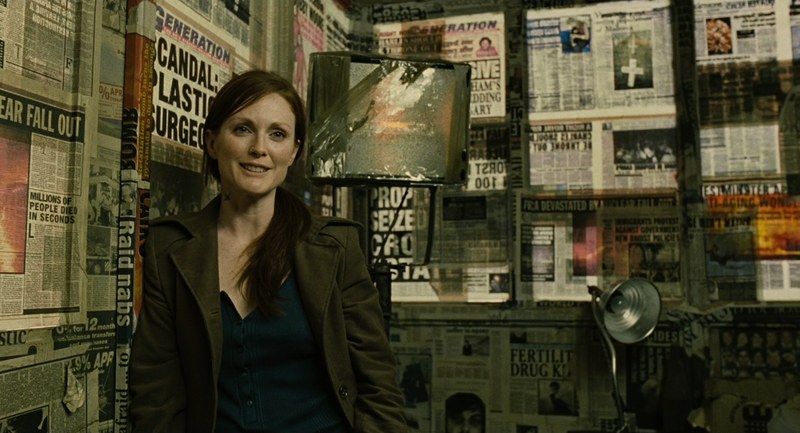
Children of Men commits fully to realism as an aesthetic principle. At the time of its release, that choice already seemed right. Now that we are so close to the year in which the film is set, almost two decades after its premiere, it looks even more precise. The movie has not aged. Thematically and visually, it feels entirely current.
Y Tu Mamá También had been a kind of return to origins for Cuarón and Lubezki. After more elaborate productions with extensive artificial lighting, they went back to something closer to the Nouvelle Vague: available light, handheld camera, fewer means, and a more porous relationship between the characters and the world around them. In Children of Men, the means are far greater, but the principle is similar. The camera almost always maintains a subjective relationship with Theo and is usually fitted with a very wide lens, between 18mm and 21mm, used wide open or close to it, around T/2.0, on a handheld camera.
The filmmakers were also among the first to make major use of what may be the most optically perfect lenses ever designed for Super 35: the Arri/Zeiss Master Primes. Their extra sharpness was clearly visible on the big screen. Some cinematographers have criticized these lenses for lacking personality, but producing a clean, precise image between T/1.3 and T/2.0 is precisely their value and, in this context, their character.
This kind of staging makes the film intensely immersive. But there is more to it than that. Cuarón often favors very long takes and relatively few cuts. He uses carefully choreographed action so that we feel placed inside the event, rather than watching a sequence edited into shape for us. Even more striking, then and now, are the film’s long takes: the car attack sequence, in which, when I first saw the film in a theater, I was so absorbed in the action that I did not even realize it was a single shot; the extraordinary birth scene, with its animatronic baby; and, of course, the long, brutal passage in which the protagonists try to escape with the child, the baby is taken away, and Clive Owen moves through a war zone to recover it. Those last two, I certainly did notice in the theater.
In that sense, Cuarón’s long takes are exemplary. They never feel, even when they are, like technical exhibitionism. They are simply the best way to place us at the center of the action and make us participate in what is happening. We suffer with Owen when the baby is about to be born, and we suffer with him again when he tries to retrieve and protect it. At that point, we are almost no longer spectators, but participants. That effect comes from exemplary staging, astonishing camera operation by George Richmond, and a level of technical and artistic precision — including the actors, of course — that is superlative.
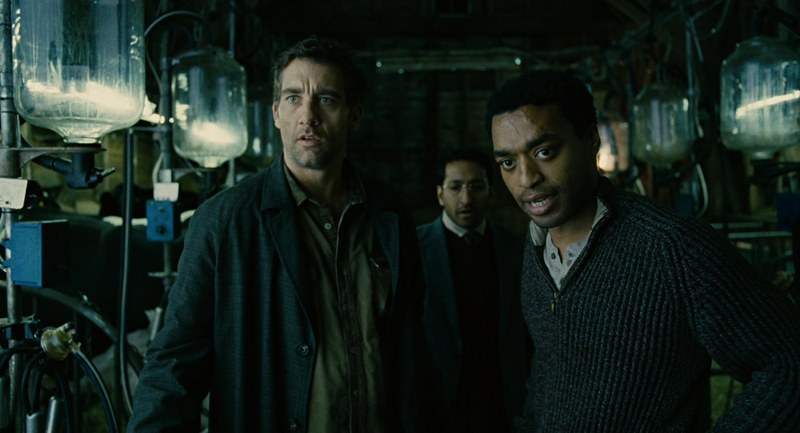
If, in terms of how it is shot, Children of Men could be one of the best-shot films in cinema history, the way it is lit is not far behind. Cuarón described his vision of the future as closer to The Battle of Algiers (Gillo Pontecorvo, 1966) than to Blade Runner (Ridley Scott, 1982). That required a direct, minimally intrusive visual approach.
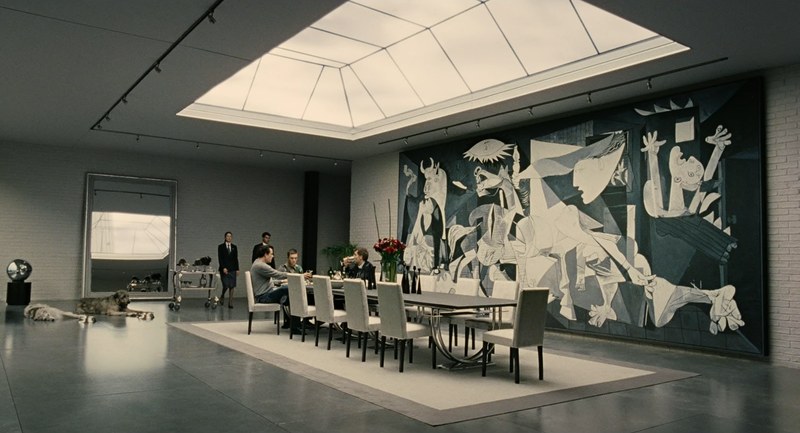
For that reason, Lubezki works in a mode that is closer in spirit to Y Tu Mamá También or The New World. Not because the films look alike, but because in Children of Men he wants the lighting, as in those films, to become invisible. It is not invisible because there is no light. It is invisible because the light is placed with such intelligence, most often through sources integrated into the sets: the city, Theo’s abduction at the beginning of the film, the prison, the rural estate from which the characters flee. These locations are full of light sources present in the frame.
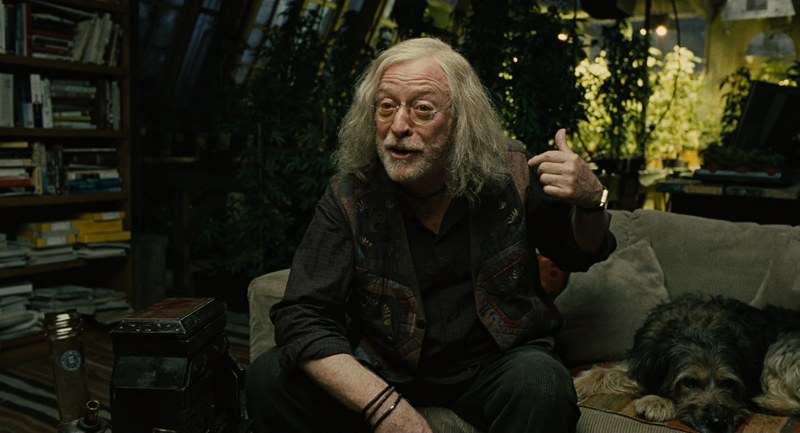
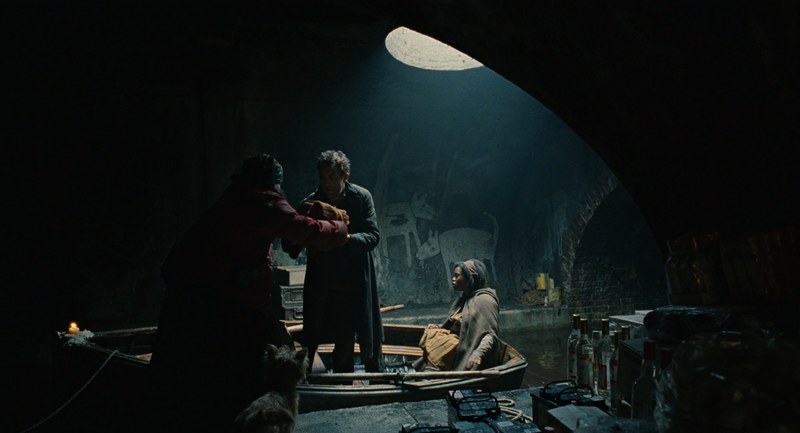
Many of those sources are industrial, greenish or sodium-based, inside an overall cold environment. They are rarely neutral. They are hostile. But in Michael Caine’s house, in the woods — the only truly positive place Cuarón allows us to see — Lubezki uses paper lamps to create softer, warmer, more human light. In most exteriors, and in many of the interiors, there is very little beyond that. What there is, however, is a formidable use of available light. The abandoned-school scene is a spectacular example: they arrived that day and found that extraordinary late-afternoon light — surely the kind of light they were chasing — but still, how on earth did they do that?
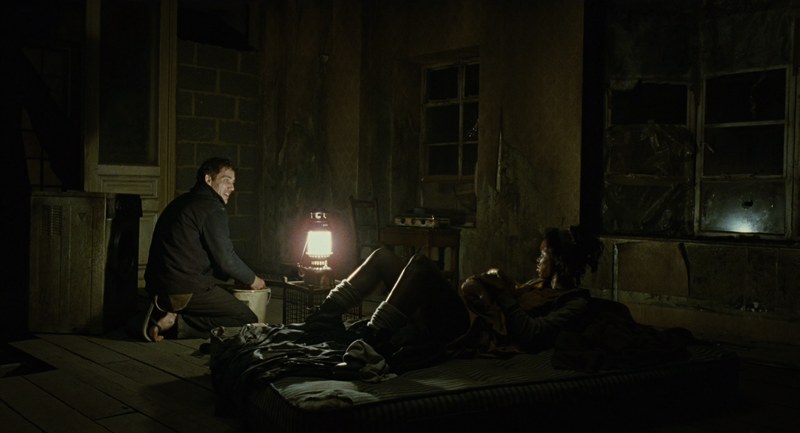
And then there is the emblematic birth scene. As mentioned above, it is a long take, lit by a single practical lantern in the frame, producing a hard, contrasty light that matches the violence and vulnerability of the situation. If Cuarón’s staging needed to feel truthful, realistic and immersive, it also needed light that allowed us to believe in that world and feel physically present within it. Lubezki achieves that magnificently. Also unforgettable is the escape at dawn, in very long shots, as the light gradually rises within the shot and from cut to cut until day breaks. It is possible that part of the effect was shaped in the Digital Intermediate, but the result remains superb.
Lubezki also chose to give the film a fairly prominent texture for its period. In the mid-2000s, Kodak’s VISION2 line offered two 500T stocks. The more common one was 5218, with medium contrast, medium saturation and relatively fine grain. The other was 5229 Expression, which Lubezki used here. It was grainier, lower in contrast and less saturated, but paradoxically allowed him to capture more information — slightly more range — than the more standard 5218.
Kodak 5229 and the Digital Intermediate
In Children of Men, Kodak VISION2 Expression 5229 produced a lower-contrast negative with restrained saturation and less densely rendered blacks than 5218, while preserving enough information for contrast, color and black density to be shaped in the 2K Digital Intermediate. The final look does not come from the film stock alone, but from the relationship between the negative, the scan and the digital grade. This workflow is examined in The Motion Picture Negative (V): Scanning, Digital Intermediate and 4K Restoration.
In that sense, Lubezki was already anticipating the logic of Kodak VISION3, the next generation of negative stocks, designed with more latitude and with scanning and digital grading increasingly in mind. VISION2 stocks were already being scanned, but they still belonged to a period in which the photochemical finish remained a central reference. They offered less information for a Digital Intermediate than later stocks would. Lubezki, who would also use a similar approach on Burn After Reading (Joel & Ethan Coen, 2007), was already choosing the flattest possible negative for later digital adjustments and integrations.
The 5229 was not only lower in contrast and grainier. It also had less dense, less deep blacks than 5218. Lubezki stated that he could adjust the black density without any problem during the digital grade. The general look, which only a few years earlier might have been achieved through bleach bypass or a related photochemical process, was now produced through the DI, with far greater control than a purely photochemical workflow would have allowed.
Final Thoughts
As a whole, the result is glorious. Children of Men is one of those iconic achievements in cinematography which, despite never trying to call attention to itself, has more lasting value than many entire filmographies. Its value does not lie only in its look, although that look is remarkable. It lies in the way every part of the budget, the staging and the lighting is directed toward one aim: making us believe what we see and feel physically involved in it. And it succeeds.
At the time, it seemed not only like the cinematography achievement of the year, but perhaps of the decade. Lubezki won the American Society of Cinematographers Award and the BAFTA, while the British Society of Cinematographers preferred the work of its own member Phil Méheux on Casino Royale (2006). The real surprise came at the Academy Awards. Lubezki was the clear favorite, but lost to his fellow Mexican cinematographer Guillermo Navarro for Pan’s Labyrinth (Guillermo del Toro, 2006).
It was a surprising result, among other reasons, because Navarro had not been nominated by the ASC. Since the ASC established its own awards in 1986, only once before had the Academy Award gone to a cinematography achievement that had not first been nominated by cinematographers: Glory, for which Freddie Francis won in 1989, though as a British cinematographer he was not a member of the ASC. Navarro had won the Golden Frog at Camerimage, where Children of Men was not in competition, but the Oscar remained controversial. Lubezki would have to wait for his three consecutive Academy Awards, not before losing again — when he was also the clear favorite — for The Tree of Life (2011), to Robert Richardson for Hugo (Martin Scorsese, 2011).
Seen in 35mm & Blu-ray.
ON FILM & DIGITAL
© Ignacio Aguilar, 2026.
This article is part of ON FILM & DIGITAL’s English-language cinematography reviews and essays.
For professional work, collaborations, lectures, workshops or cinematography consulting, visit his professional biography, selected works or contact page.
The Author
Ignacio Aguilar, AEC, in addition to being the author and editor of ON FILM & DIGITAL, is a working cinematographer. He has photographed feature films such as La Pasajera (Fernando González Gómez, Raúl Cerezo, 2021), Viejos (Fernando González Gómez, Raúl Cerezo, 2022), Rabios@ (Luis Mª Ferrández, 2025), and the Spanish scenes of the Western Dead Souls (Alex Cox, 2025). His forthcoming feature is Los Que Vienen (Víctor Català, 2026). He also teaches and collaborates with several film schools and educational institutions, including TAI, ESCAC, THE CORE and ECAM, among others. He is a Sony Independent Certified Expert (ICE), as well as the Spanish ambassador for Cooke SP3 lenses. The opinions expressed are strictly his own.