

“Disclosure Day”
Spanish Title: El día de la revelación
Year of Production: 2026
Director: Steven Spielberg
Director of Photography: Janusz Kaminski
Lenses: Panavision T Series, C Series and Primo Close Focus
Film Stocks: Kodak VISION3 500T 5219, 200T 5213, 250D 5207 and 50D 5203
Format and Aspect Ratio: 35mm anamorphic Panavision + ARRI Alexa 35 + Sony VENICE 2 + DJI Inspire 3, 2.4:1
Other: 4K Digital Intermediate
Viewed on: 4K HDR
Janusz Kaminski combines 35mm anamorphic photography, digital capture and unmistakably Spielbergian camera staging in “Disclosure Day.”
The Film
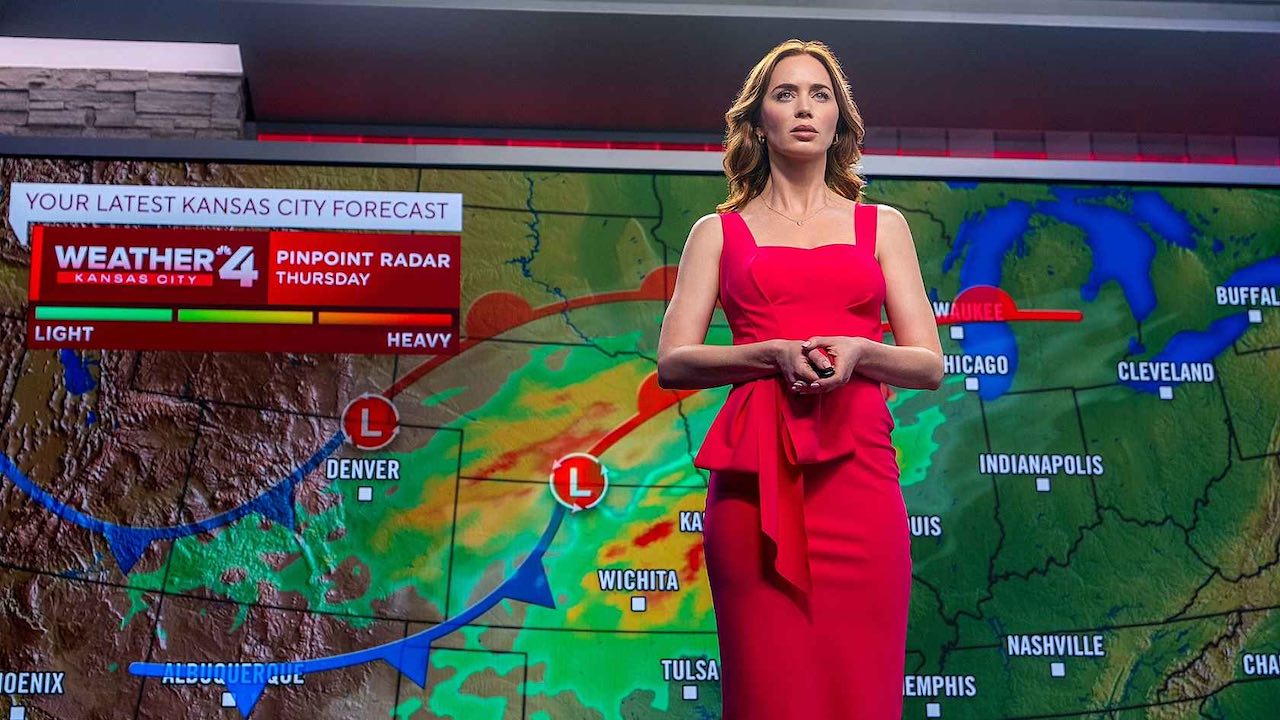
Steven Spielberg’s long-awaited return to science fiction centers on a television weather presenter, played by Emily Blunt, who suddenly discovers that she can read minds and access personal information about the people she encounters. This leads her to join forces with a cybersecurity analyst, played by Josh O’Connor, who has obtained conclusive evidence of extraterrestrial life and of a decades-long effort to conceal it from the public.
Written by David Koepp — Jurassic Park, War of the Worlds — much of Disclosure Day inevitably moves through familiar territory. The first half establishes a system of rules that strongly evokes Minority Report (2002). In the second half, the protagonists leave everything behind to pursue their mission, bringing the film closer to Close Encounters of the Third Kind (1977).
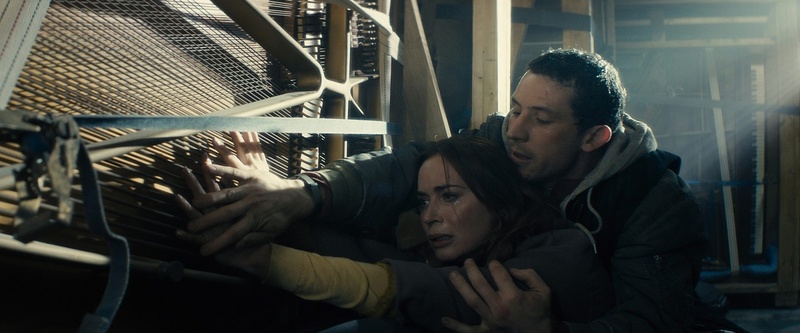
Even so, Disclosure Day retains an identity of its own. It is intelligent, engaging and entertaining, although its resolution may feel too innocent for many adult viewers in 2026 and lacks the emotional force of Close Encounters. Colin Firth, Eve Hewson, Colman Domingo and Wyatt Russell, among others, complete the cast.
The Cinematographer
The cinematographer is Polish-born Janusz Kaminski, Steven Spielberg’s regular collaborator since Schindler’s List (1993), which earned him his first Academy Award. His second followed in 1998 for Saving Private Ryan. Since then, he has photographed every Spielberg feature, including Catch Me If You Can (2002), Munich (2005), War Horse (2011), Lincoln (2012), Bridge of Spies (2015), The Post (2017), West Side Story (2021) and The Fabelmans (2022), among others.
Outside Spielberg’s orbit, however, Kaminski has worked comparatively little. Jerry Maguire (Cameron Crowe, 1996), The Diving Bell and the Butterfly (Julian Schnabel, 2007) and The Call of the Wild (Chris Sanders, 2020) are some of the principal exceptions.
Visual Style Analysis
Disclosure Day is one of the relatively few present-day stories Spielberg and Kaminski have made together. At least during its first half, the film also sets out to adopt some of the visual language and narrative grammar of 1970s cinema. Despite its contemporary setting, the result has a deliberately classical appearance.
The available documentation confirms a hybrid analog-and-digital approach: approximately two thirds of the film was shot on 35mm and one third digitally. The principal format is 35mm anamorphic, using Panavision T Series lenses, supplemented by spherical Primo lenses and some C Series anamorphics. Digital capture combined the ARRI Alexa 35 and Sony VENICE 2, while several aerial shots were photographed with drones, including the DJI Inspire 3.
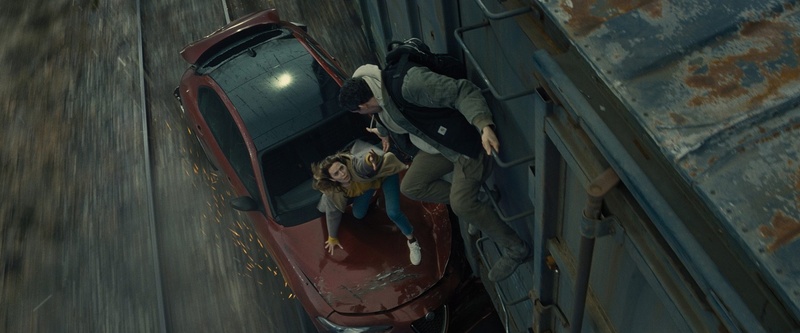
The precise assignment of each camera to individual sequences has not been fully documented. Judging from the finished film, the Alexa 35 may have been used for some of the night work and perhaps for the opening television-studio scenes with Emily Blunt. Certain car interiors appear to have been photographed with the VENICE 2, while isolated shots also suggest the optical character of spherical Primos and an occasional zoom. After a careful grade and a 4K finish, the distinctions are difficult to isolate. The Digital Intermediate integrates the different sources into the master almost seamlessly.
From Film Stock to the Digital Intermediate
In a hybrid production such as Disclosure Day, the Digital Intermediate is more than a color-grading stage: it is where the scanned negative and the different digital cameras are brought into a common structure of contrast, color and texture. For a detailed explanation of how film stock, exposure, processing, scanning and the DI shape the final image, see the Guide to the Motion Picture Negative: Film Stock, Exposure, Processing, Scanning and DI.
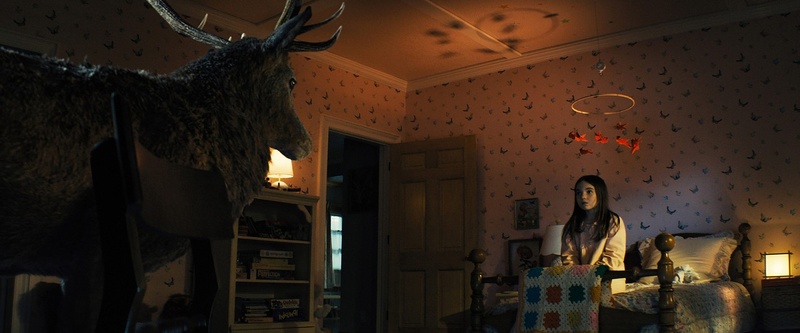
The color palette is relatively restricted outside the television studio. Each sequence is built around a distinct color bias and tends to remain fairly monochromatic within it. At times the effect recalls Minority Report, although no silver-retention process is involved here. Some scenes are warm, others gray or blue, and the film occasionally returns to the shafts of light cutting through smoke that have long been associated with Kaminski.
His use of filtration is more restrained than usual. Several sequences employ strong backlight and give the actors a noticeable halo, but compared with War of the Worlds, the effect is almost discreet. Anamorphic flares are more prominent: the familiar horizontal blue streak, sometimes accompanied by additional colored artifacts, is characteristic of the Panavision T Series. The lenses also suit Spielberg’s style because they focus considerably closer than many classic anamorphic sets.
There is also some diffusion on Emily Blunt’s close-ups, visible in the small particles and specks suspended in the bokeh. The close-ups appear to combine Glimmerglass filters with the older Panchro/Mitchell diffusion system, softening fine detail in a way broadly comparable to the later Tiffen Soft/FX filters.
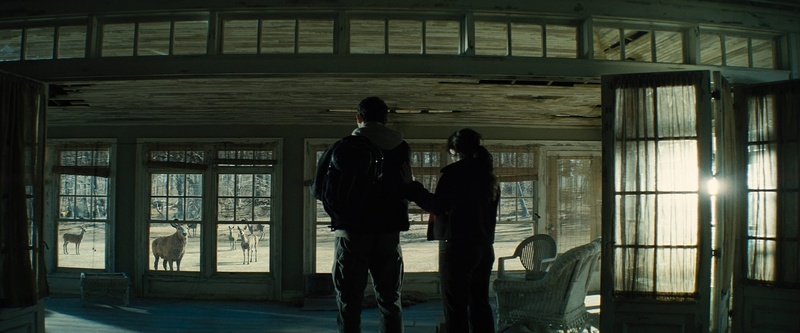
The film has a clearly defined visual approach: directional, contrasty light, cool or warm depending on the sequence, and a generally polished finish. Even so, Kaminski keeps his signature relatively subdued, apart from the familiar shafts of light and fixtures placed almost inside the frame. In that sense, there is a parallel with some of Robert Richardson’s later work, such as Once Upon a Time… in Hollywood, whose visual signature is less overt than in earlier work such as Casino or JFK.
Where the film truly excels, unsurprisingly, is in Spielberg’s camerawork. The return to anamorphic widescreen is welcome. Spielberg has used the format exceptionally well throughout his career, but what is more striking is how fully his compositional instinct and camera-based storytelling remain intact as he approaches eighty.
There are long takes, Steadicam sequences and, of course, the kind of staging in which the camera establishes a composition and a pattern of blocking, the actors shift position, and the camera moves with them until a new, perfectly balanced frame emerges. The process may repeat several times within a single shot.
What is particularly striking here is the extent to which Spielberg and Kaminski have embraced drones, almost literally. In the sequence most likely to be remembered from Disclosure Day, the camera follows Josh O’Connor as he arrives at a farm cordoned off by police. The drone follows him with the sweep of a crane, drops to ground level — where a crew member catches it by hand — circles the actor, threads through a fence and continues the action. The shot is showy and elegant, yet classical in the way it communicates space and narrative information. It demonstrates that the staging remains in the hands of a master.
Conclusion
The results are very good overall, above all because the staging is so intricate and consistently engaging. From a strictly aesthetic standpoint, Disclosure Day may sit slightly below Kaminski’s finest work, or even below films that were not necessarily better photographed — Minority Report again comes to mind — but were more expressive and original. Here, however, the work is more coherent and visually consistent, qualities I have often found missing from the Polish cinematographer’s work.
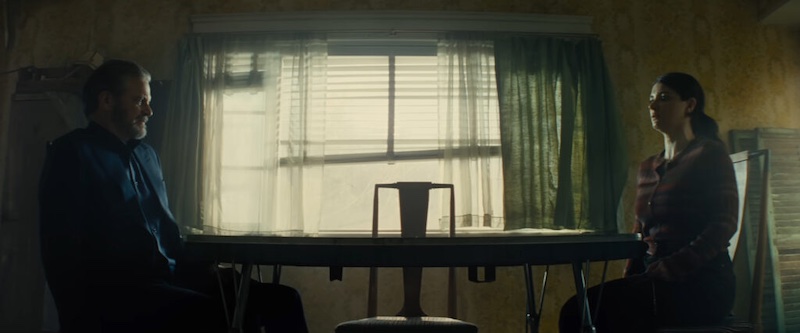
In that sense, aside from the occasional flare, slight veiling and a handful of other recognizable signatures, the film feels more like an assured demonstration of Kaminski’s craft than a particularly inspired piece of lighting design. But because the camerawork is so compelling, Disclosure Day looks very good and remains highly enjoyable. It has a classical visual sensibility and relies on largely physical production methods that is, unfortunately, becoming increasingly rare.
ON FILM & DIGITAL
© Ignacio Aguilar, 2026.
This article is part of ON FILM & DIGITAL’s English-language cinematography reviews and essays.
These texts are not plot summaries or general film reviews, but cinematography-focused essays written from the perspective of a working cinematographer.
The Author
Ignacio Aguilar, AEC is a cinematographer / director of photography based in Madrid, Spain. His work spans feature films, television, commercials and technical writing on cinematography, with experience in digital cinema, 16mm and 35mm film, anamorphic lenses, large-format digital capture, lens testing and film-based workflows.
He is a member of the Spanish Society of Cinematographers (AEC) and the Spanish Academy of Cinema, a Sony I.C.E. Certified Expert and a Cooke SP3 ambassador. His writing has appeared in American Cinematographer and Camera & Light, and ON FILM & DIGITAL gathers his bilingual essays, technical guides and cinematography reviews.
For professional work, collaborations, lectures, workshops or cinematography consulting, visit his professional biography, selected works or contact page.
The Spanish-language archive is available at ON FILM & DIGITAL.