


“Blow Out”
Spanish Title: Impacto
Year of Production: 1981
Director: Brian De Palma
Director of Photography: Vilmos Zsigmond, ASC
Lenses: Panavision C Series, Super PanaZoom Cooke
Film Stock: Kodak 5247 (125T)
Format and Aspect Ratio: 35mm anamorphic (Panavision), 2.4:1
Other: additional photography (uncredited) by Laszlo Kovacs, ASC
Viewed on: Blu-ray
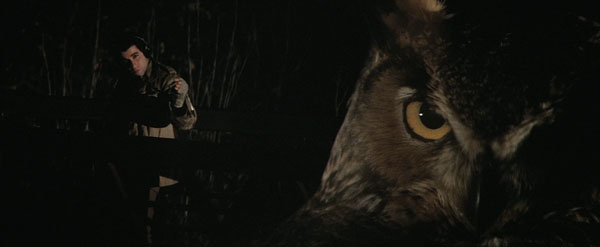
Vilmos Zsigmond’s cinematography turns Brian De Palma’s virtuoso staging into a decisive transition between the textured 1970s and a sharper, more industrial image.
The Film
Blow Out revisits the premise of Michelangelo Antonioni’s Blow-Up (1966), later approached by Francis Ford Coppola in “The Conversation” (1974). Jack Terry (John Travolta), a sound technician working on low-budget films, accidentally records the car crash that kills the governor of Pennsylvania, the leading presidential candidate. The sound he captures, together with several inconsistencies in the official account, convinces him that someone is concealing an uncomfortable truth.
De Palma does not use the material as Antonioni or Coppola did, nor does he seem primarily interested in the political and conspiratorial implications found in Alan J. Pakula’s 1970s classics—“Klute,” “The Parallax View” and “All the President’s Men.” What clearly drives him is the opportunity for an elaborate exercise in style and staging as his camera follows Travolta, in one of his finest performances, through the attempt to uncover the truth. Judged on those terms, the film is highly successful, including the dark resolution that closes the story. De Palma regulars John Lithgow, Nancy Allen and Dennis Franz share the screen with Travolta.
The Cinematographer
After working with several cinematographers throughout the previous decade, De Palma finally returned to one of them: Hungarian cinematographer Vilmos Zsigmond, ASC. They would later collaborate again on The Bonfire of the Vanities (1990) and The Black Dahlia (2006), which earned Zsigmond the last of his Academy Award nominations. One of the most important and influential cinematographers of his generation, Zsigmond left Hungary for the United States after the Soviet invasion and began his American career on very small productions.
His work took a decisive leap in the early 1970s through his collaborations with Robert Altman—“McCabe & Mrs. Miller,” Images and The Long Goodbye—followed by films such as “Deliverance” (John Boorman, 1972), “The Sugarland Express” (Steven Spielberg, 1974) and “Obsession” (Brian De Palma, 1976). He won the Academy Award for his second and final collaboration with Spielberg, “Close Encounters of the Third Kind” (1977), and received another nomination the following year for “The Deer Hunter” (Michael Cimino, 1978). Before Blow Out, Zsigmond and Cimino embarked on a vast production whose undeniable artistic qualities did not prevent a catastrophic commercial reception: “Heaven’s Gate” (1980).
Visual Style Analysis
The cinematography of Blow Out marks a pronounced change from the style that had defined Zsigmond’s work during the previous decade. His images had often been soft and diffused, shaped not only through lighting but through techniques such as flashing and Double-Fog filtration. Those methods were not foreign to De Palma when working with other cinematographers. “Carrie” (1976) and his previous film, “Dressed to Kill,” photographed by Ralf Bode, share much of the visual language associated with Zsigmond at the time.
Blow Out, Zsigmond’s next feature after Heaven’s Gate, is instead defined by images that are sharper and more saturated, far removed in texture from most of his earlier work. The change may well be connected to the reception of Cimino’s film. Its period cinematography—yellowed, heavily softened, low in contrast and filled with smoke—was widely attacked when the film opened, almost exactly as production on Blow Out began in November 1980. In Masters of Light, Zsigmond described this new direction as more “industrial”: far less diffusion and filtration, virtually no atmospheric smoke, and a more frequent reliance on prime lenses. The expressive intent remains, but it moves away from photochemical degradation toward cleaner, more controlled precision.
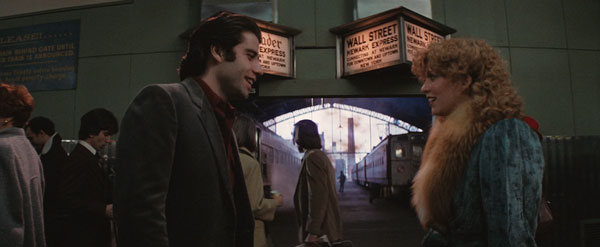
Photographed in anamorphic widescreen, the film is distinguished above all by De Palma’s command of staging. He uses the full width of the frame, often placing characters at opposite edges; split screens; split diopters that hold a foreground object and the background in focus at once; overhead angles; 360-degree camera moves; slow motion; Steadicam tracking shots; and extensive zoom work used as a narrative device. The zooms also draw on a tool with which Zsigmond had always been particularly comfortable.
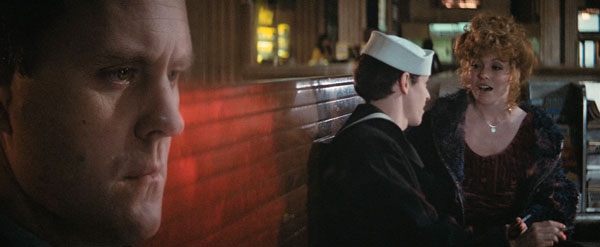
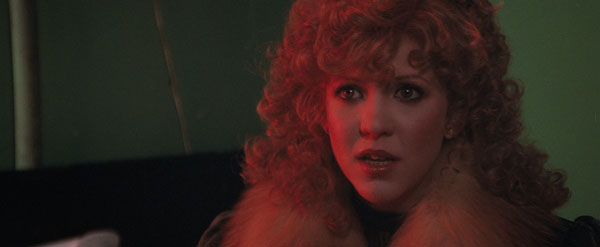
Because the film was designed around a deliberately sharp image, Blow Out looks rawer, more immediate and more industrial than Dressed to Kill or any earlier Zsigmond film, without approaching the near-documentary realism of “The French Connection” (1971). The texture is grainy and the blacks are generally dense and deep. Color is comparatively restrained apart from the primary reds Zsigmond introduces in several scenes. The result occasionally resembles ENR, the retention process first used that same year on Warren Beatty’s Reds. In the case of Blow Out, however, the Criterion Collection Blu-ray may have intensified this quality through digital grading beyond what 35mm prints originally displayed.
Where Zsigmond had previously favored soft, delicate tonal transitions, here they are far more abrupt. Light and shadow can separate sharply within the frame. The clearest example is the large exterior built around the accident sequence. Zsigmond used powerful units to bring selected areas to the required exposure, allowing everything beyond their reach to fall into complete blackness.
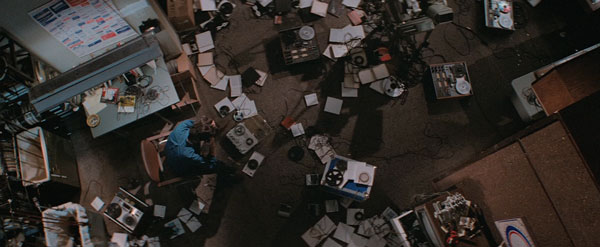
The lighting remains grounded in realism, but it also begins to move away from the dominant 1970s aesthetic. Primary reds recur throughout the film, while practical fluorescents are allowed to remain uncorrected, contributing green-blue tones that anticipate the more stylized visual language of the 1980s. A comparable transition can be seen in Michael Mann’s “Thief” (1981), another film that carries elements of both decades. Zsigmond keeps his approach relatively simple, using only the equipment each sequence requires. The accident scene was exceptionally complicated and several night exteriors clearly demanded very large units, but much of the atmosphere is built from Paul Sylbert’s practical lighting, reinforced as needed for exposure.
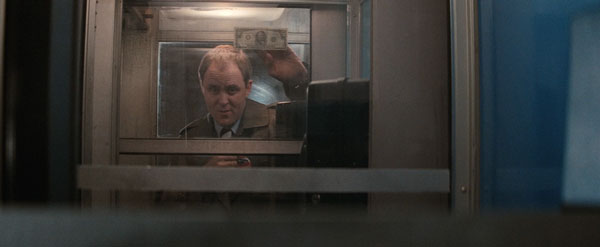
The result is neither strictly realistic, conventionally beautiful nor immediately spectacular. It occupies a midpoint between two visual periods, yet it serves the story effectively and remains technically accomplished. The Kodak 5247 (125T) negative had to be push-processed for numerous interiors and night scenes photographed with the Super PanaZoom 40–200mm T4.5 and 50–500mm T5.6 lenses. When the available light was insufficient for those slow zooms, the filmmakers moved to the wider apertures of the Panavision C Series anamorphic primes, producing noticeable variations in depth of field. Blow Out is consequently one of the Zsigmond films in which prime lenses appear most often, rather than being reserved for isolated situations.
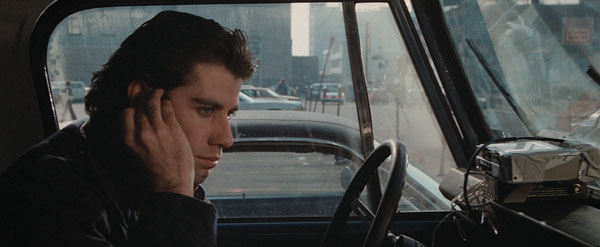
Conclusion
The sudden stylistic break from Dressed to Kill and Heaven’s Gate—the immediately preceding films of De Palma and Zsigmond respectively—is apparent from the beginning. Even so, the finest passage is the final night sequence, when slow motion takes over and fireworks illuminate both the characters and the setting. Two rolls of film were reportedly stolen before editing, forcing part of the sequence to be reshot. Zsigmond was no longer available, so his friend and colleague Laszlo Kovacs, ASC, completed the additional photography.
Whoever photographed the individual shots used in the finished film produced exceptional work under demanding technical conditions, including blue-screen photography that keeps the characters and fireworks simultaneously sharp. The opening sequence is equally memorable: a parody of Halloween in which Garrett Brown’s Steadicam adopts a killer’s point of view as he watches his victims. It establishes De Palma’s tone immediately and announces the visual display that follows.
ON FILM & DIGITAL
© Ignacio Aguilar, 2026.
This article is part of ON FILM & DIGITAL’s English-language cinematography reviews and essays.
These texts are not plot summaries or general film reviews, but cinematography-focused essays written from the perspective of a working cinematographer.
The Author
Ignacio Aguilar, AEC is a cinematographer / director of photography based in Madrid, Spain. His work spans feature films, television, commercials and technical writing on cinematography, with experience in digital cinema, 16mm and 35mm film, anamorphic lenses, large-format digital capture, lens testing and film-based workflows.
He is a member of the Spanish Society of Cinematographers (AEC) and the Spanish Academy of Cinema, a Sony I.C.E. Certified Expert and a Cooke SP3 ambassador. His writing has appeared in American Cinematographer and Camera & Light, and ON FILM & DIGITAL gathers his bilingual essays, technical guides and cinematography reviews.
For professional work, collaborations, lectures, workshops or cinematography consulting, visit his professional biography, selected works or contact page.
The Spanish-language archive is available at ON FILM & DIGITAL.